I hope councils and Mayor will measure the effects of ULEZ both inside and outside the zone?
She lived on the boundary, she died. So, not many then.
1 Like
Do you think there has only been one premature death in the country linked to air pollution? Ok.
Is that a serious question?
I’m just an angry old bloke who doesn’t have any of the factual data that local concillors have at their fingertips - so instead of being all cocky, why don’t you simply do your job and, perhaps, concentrate on the part of my post that you might actually be able to help with and let us know about the mitigation measures that will be put in place?
4 Likes
Yes. I want you to view the bigger picture and think about the millions of lives that will be likely be improved within the north & south circular. I’m sure we, Lewisham Council & TFL, will measure the impact on air quality inside and outside the extended ULEZ and make a judgement on its future based on the greater good for all Londoners.
Do the council and the (useless) Mayor of London have any plans to actually tackle air pollution, as opposed to concentrating congestion in unlucky areas, shuffling pollution and fining people for going about their daily business?
Here are some positive suggestions:
Plant lots of trees (rather than chopping them down).
Put a limit on the densification of London rather than continuing the ideological house-building and Population Ponzi Scheme, with all the extra pollution this entails.
Look at the below image.
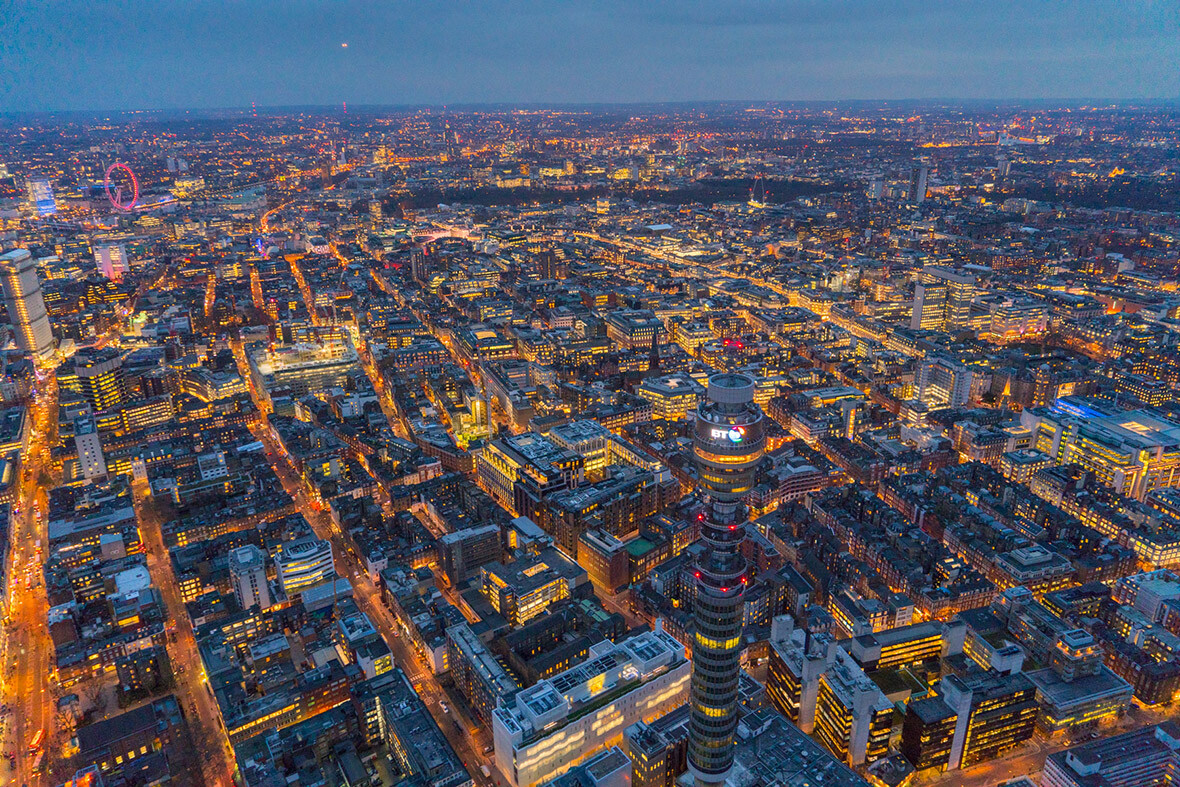
If you see this and conclude “this area needs more urbanisation,” then you need to give your head a good wobble. If you cannot afford to live there, do what everyone else does, and go live somewhere you can afford to. Don’t demand that more houses are built in London in some perverse attempt at manipulating prices.
Embrace the electric future of transport - starting with promoting (not trying to cancel) Uber. End the special treatment of the Black Cab lobby. Why should their overpriced diesel-chugging often-empty vehicles get privileged access to bus lanes? Incentivise zero emissions vehicles by allowing them into bus lanes (reducing congestion in other lanes). And build more chargers and protect them with anti-ICEing enforcement.
Get those god-awful diesel busses off the road!
Revert the foolish LTNs and blanket #20mph limits and road narrowing. All they’ve acheived is longer journeys and more congestion.
Stop making things worse and start making things better.
3 Likes
So that was a serious question - to me. Well how the hell do I know!
I can just see imagine every driver who can’t afford a non-polluting car or the £12.50/day charge, who might otherwise be able to filter their way to their destination, will instead be chugging slowly (at a walking pace) along the S.Circ and some of our other roads (on the periphery of the ULEZ), like Dartmouth Road, which I envisage suffering more concentrated and higher levels of pollution than they do today; and this bothers me because I feel a particular responsibility for my residential and commercial tenants and their respective customers (on D. Rd), all of whom could be adversely affected because they need to live, work and walk alongside what will inevitably be a slower and more regular traffic jam between Forest Hill station and the swimming pools, which is my reason for being interested what you might have to say about mitigation measures for them (and other Lewisham residents), after which I might be more inclined to open my mind up to your ‘bigger picture’.
6 Likes
Well all have a responabilty to drive less. There is always a lot of defensive jusitifcation from people whenever air pollution or congestion is mentioned that THEIR car use is justified and essential. Not like others obviously.
We all need to do better here.
2 Likes
We all need to think better.
And we need to do away with attitudes and policies that pit residents against residents. The path to lower emissions is a positive one. Not a stupid and counterproductive war where those who rely on vehicles and the road network (which is all of us, directly or indirectly) must lose.
I guess people are relying on the councillors of SE23 to stand up for the needs of their local areas.
It is great news that the majority of people in London should benefit from ulez extension.
However, the majority of people in SE23 live within 0.5 or 1 mile of the South Circ, and therefore are likely to be negatively impacted if the South Circ sees more traffic as a consequence.
It’d be good to know what plans are in place to ensure ulez extension works just as well for SE23 residents, as for other living miles away in inner London who definitely will benefit from cleaner air.
(I am not a car driver).
4 Likes
Meanwhile on the same day as the inquest, Lewisham approved plans to build Blackheath Business Estate, 63 flats next to the A2, also removing 36 mature trees in the process:
Note, I’ve highlighted the roles of our local councillors, and while the article may have some bias, and I recognise there is a shortage of affordable housing, it does seem to be some kind of madness to chop down trees to build flats in already polluted areas.
1 Like
I totally agree.
Being an angry old bloke, and one who’s OldtoSE, I’m afraid I rant too much to be able to put a point forward as rationally as you’ve done here.
Hopefully @LeoGibbons will come back on to tell us what pollution mitigation measures are being put into place that will make the extended ULEZ benefit his constituents and everyone in SE23 so that it can truly be seen to be for “the greater good for all Londoners”, as he says.
2 Likes
How is this:
Compatible with this?:
The arguments that London is full and too densely populated are tired, London is a sprawling low density city compared to many others with better air quality.
Personally I live only a few minutes walk from the south circular so stand to see the downsides of this close to my flat, but I don’t think not doing it is better. As with LTNs, I expect the ultimate aim will be to discourage car use rather than shift it elsewhere (and in this case targeted at the higher polluting cars) to transport modes that are less detrimental and I support that even if it takes time to come to fruition. Surely these same arguments could have also been made by anyone on the edge of the CC zone, or any road that benefits from traffic calming - doing nothing doesn’t help anyone.
1 Like
Let me explain it to you.
A two-tier system where the council chooses:
- some people to receive half-price housing
- everyone else to pay for the chosen few to receive this discount, in addition to paying for their own full-price housing
Is divisive, and pits residents against residents.
Thank you for trying to explain but now I’m really not sure what you’re talking about… At what point in housebuilding considerations does a council choose to give some of the properties away at half price to certain people?
I’m not getting drawn into a ping-pong side discussion with you, so I’ll leave it at this: Have a read of the 853 article provided by @ForestHull above, which states that the residents chosen to live in “affordable house” will pay just half of the real-world market rent.
1 Like
So be it, but on your final point the affordable rents offered are hardly a random giveaway, they apply to those eligible to social housing and therefore have a means test applied, and as a condition of planning it isn’t clear that this does impose a cost on anyone other than the housebuilder. Remember, we need to do away with attitudes and policies that pit residents against residents.
1 Like
it would be good to understand what the plans are yes. if there are plans, and said plans are robust, then there will be no issue. better to share the info with us now.
3 Likes
I totally agree with you.
2 Likes
I think we often need to think of the smaller picture first and what our local politicians can control.
Most people support a school street for Thorpewood Avenue but don’t understand why it should exclude the kids from the school with classroom windows 4 metres away from the road and only be for the benefit of the kids in classrooms 40 metres away from traffic. It will halve the pollution for the kids far away which is great while doubling the pollution for those near to it which isn’t right.
I did ask the council if they have looked at the impact to the Dartmouth Road junction beside Holy Trinity school of making it the only exit from Thorpewood but they told me they only measured through traffic from Kirkdale outside Eliot Bank. I would be sceptical about Lewisham measuring any impact for the ULEZ as they can’t seem to do the basics on a small scheme.
One of the consequences of the school scheme is a permanent one way street on half of Thorpewood. This seems to be a disproportionate measure as residents not benefiting from the scheme instead of having 10 hours of inconvenience per week will have 168 hours of extra pollution and cost. It means that traffic will only have one exit instead of 2 currently and will have to travel a longer distance.
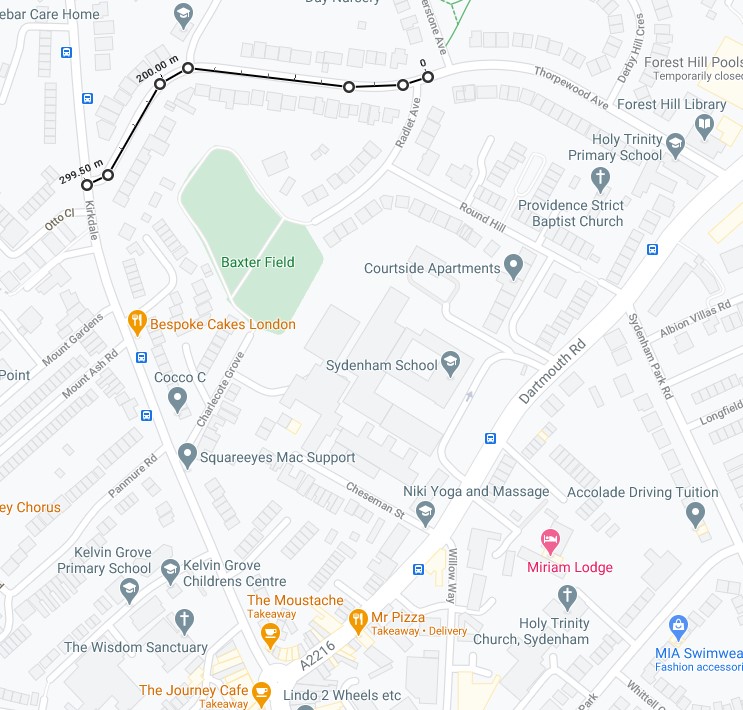
Below is a simple map of the journey a local resident living below the school street can take out via Kirkdale which is about 300 metres to exit if they want to go towards Dulwich, the second map shows the journey after the one way is imposed which takes 1.15km, a difference of approximately 1km.
Journey Before One-Way 299.50m
Journey After One-Way 1.15Km
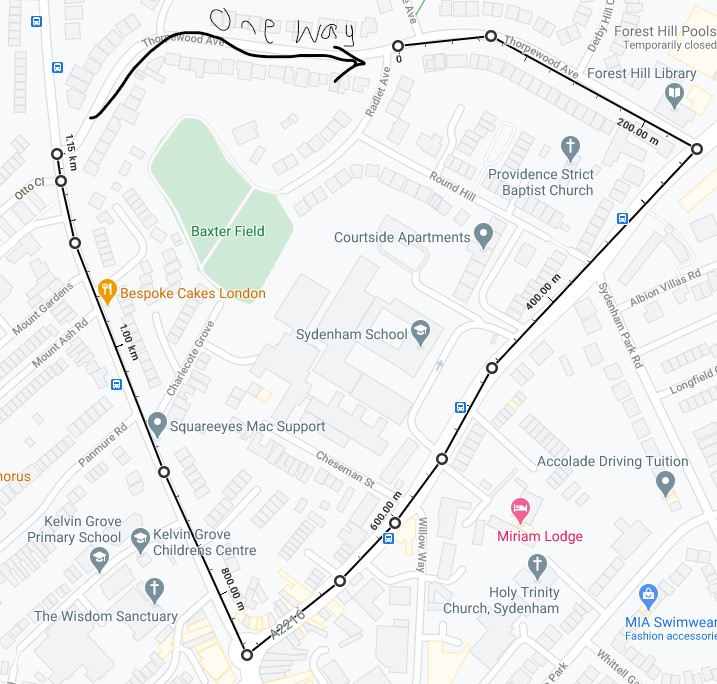
This new route will cost a local resident who drives daily an extra £100 a year, the occasional motorist who only makes the journey twice a week about £30. This is based on the HMRC mileage allowance rate which takes into account fuel, wear and tear.
Cost is only one thing. The new route forces cars past Holy Trinity School and many other residents, braking outside the school and discharging brake dust with cyanide particles. This will add up to 5 minutes to local residents’ journeys and worst of all add about half a million grams of Carbon Dioxide to the local area. This is estimated based on council lockdown traffic figures for Thorpewood Avenue which are probably less than half of what traffic is normally like so probably more likely to be an extra million grams of CO2 for residents and children not chosen by our local councillors. CO2 figures per car comes from BBC.com.
I think we need something like a pollution ombudsman to hold the council to account to give them a financial incentive to mitigate toxic air for all residents whether caused by external issues such as the South Circular/ULEZ or their local schemes.
3 Likes