Meanwhile on the same day as the inquest, Lewisham approved plans to build Blackheath Business Estate, 63 flats next to the A2, also removing 36 mature trees in the process:
Note, I’ve highlighted the roles of our local councillors, and while the article may have some bias, and I recognise there is a shortage of affordable housing, it does seem to be some kind of madness to chop down trees to build flats in already polluted areas.
Being an angry old bloke, and one who’s OldtoSE, I’m afraid I rant too much to be able to put a point forward as rationally as you’ve done here.
Hopefully @LeoGibbons will come back on to tell us what pollution mitigation measures are being put into place that will make the extended ULEZ benefit his constituents and everyone in SE23 so that it can truly be seen to be for “the greater good for all Londoners”, as he says.
The arguments that London is full and too densely populated are tired, London is a sprawling low density city compared to many others with better air quality.
Personally I live only a few minutes walk from the south circular so stand to see the downsides of this close to my flat, but I don’t think not doing it is better. As with LTNs, I expect the ultimate aim will be to discourage car use rather than shift it elsewhere (and in this case targeted at the higher polluting cars) to transport modes that are less detrimental and I support that even if it takes time to come to fruition. Surely these same arguments could have also been made by anyone on the edge of the CC zone, or any road that benefits from traffic calming - doing nothing doesn’t help anyone.
Thank you for trying to explain but now I’m really not sure what you’re talking about… At what point in housebuilding considerations does a council choose to give some of the properties away at half price to certain people?
I’m not getting drawn into a ping-pong side discussion with you, so I’ll leave it at this: Have a read of the 853 article provided by @ForestHull above, which states that the residents chosen to live in “affordable house” will pay just half of the real-world market rent.
So be it, but on your final point the affordable rents offered are hardly a random giveaway, they apply to those eligible to social housing and therefore have a means test applied, and as a condition of planning it isn’t clear that this does impose a cost on anyone other than the housebuilder. Remember, we need to do away with attitudes and policies that pit residents against residents.
it would be good to understand what the plans are yes. if there are plans, and said plans are robust, then there will be no issue. better to share the info with us now.
I think we often need to think of the smaller picture first and what our local politicians can control.
Most people support a school street for Thorpewood Avenue but don’t understand why it should exclude the kids from the school with classroom windows 4 metres away from the road and only be for the benefit of the kids in classrooms 40 metres away from traffic. It will halve the pollution for the kids far away which is great while doubling the pollution for those near to it which isn’t right.
I did ask the council if they have looked at the impact to the Dartmouth Road junction beside Holy Trinity school of making it the only exit from Thorpewood but they told me they only measured through traffic from Kirkdale outside Eliot Bank. I would be sceptical about Lewisham measuring any impact for the ULEZ as they can’t seem to do the basics on a small scheme.
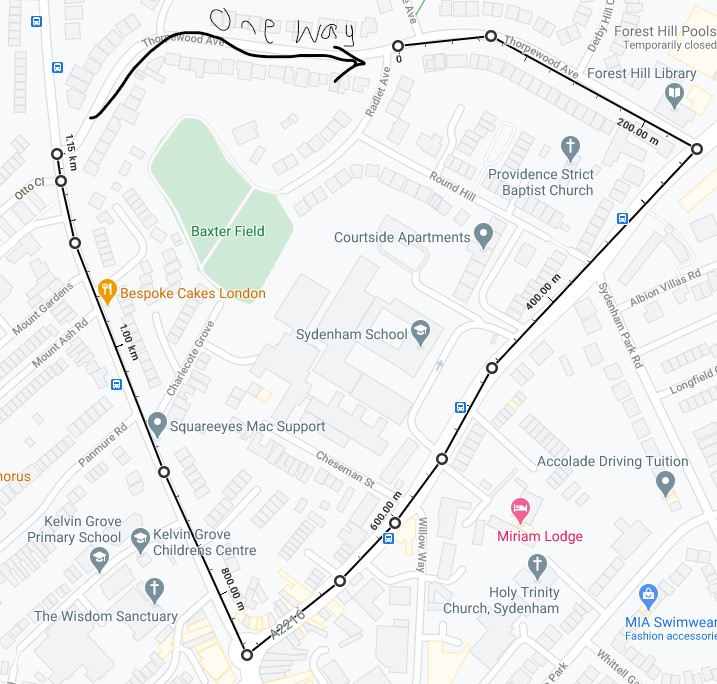
One of the consequences of the school scheme is a permanent one way street on half of Thorpewood. This seems to be a disproportionate measure as residents not benefiting from the scheme instead of having 10 hours of inconvenience per week will have 168 hours of extra pollution and cost. It means that traffic will only have one exit instead of 2 currently and will have to travel a longer distance.
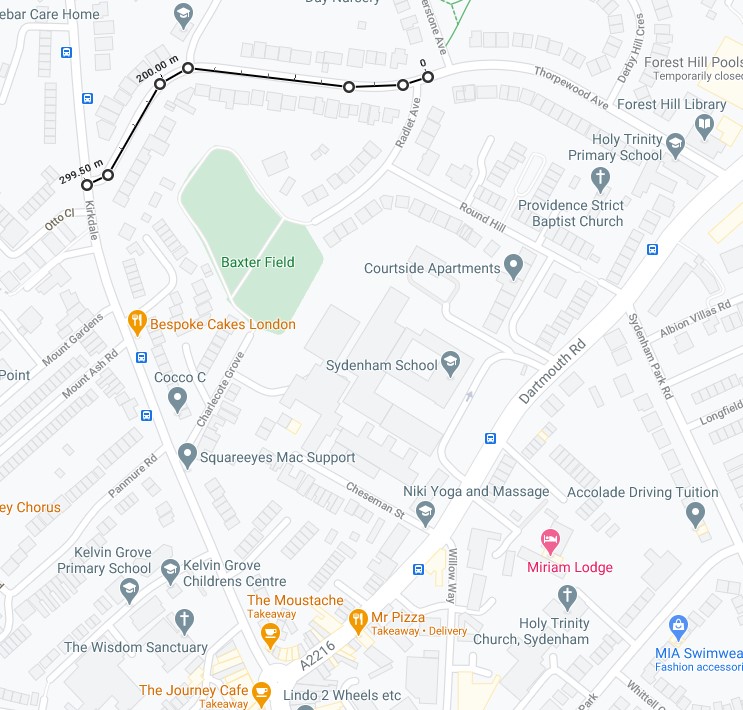
Below is a simple map of the journey a local resident living below the school street can take out via Kirkdale which is about 300 metres to exit if they want to go towards Dulwich, the second map shows the journey after the one way is imposed which takes 1.15km, a difference of approximately 1km.
This new route will cost a local resident who drives daily an extra £100 a year, the occasional motorist who only makes the journey twice a week about £30. This is based on the HMRC mileage allowance rate which takes into account fuel, wear and tear.
Cost is only one thing. The new route forces cars past Holy Trinity School and many other residents, braking outside the school and discharging brake dust with cyanide particles. This will add up to 5 minutes to local residents’ journeys and worst of all add about half a million grams of Carbon Dioxide to the local area. This is estimated based on council lockdown traffic figures for Thorpewood Avenue which are probably less than half of what traffic is normally like so probably more likely to be anextra million grams of CO2 for residents and children not chosen by our local councillors. CO2 figures per car comes from BBC.com.
I think we need something like a pollution ombudsman to hold the council to account to give them a financial incentive to mitigate toxic air for all residents whether caused by external issues such as the South Circular/ULEZ or their local schemes.
We have a profound housing crisis. Under the draft London Plan we have a target of building 2,117 additional dwellings per year.
The scheme would replenish greenery on the site and it was argued it would improve biodiversity on the site.
Desperately needed new homes would be built, including new social homes, and crucial new high-quality business space. The homes were of a good quality, replacing an unattractive low-density business space.
When putting forward my motion, I acknowledged that the development may have a negative impact on Cardinal House and Chalkhill House residents, as they will be looking onto a ‘green wall’ rather than some trees. However, on balance, this development was in line with our policies and offered the greater good to our wider community.
I think densifying London with new homes, releasing people from overcrowded homes and allowing more people to live close to public transport hubs and the jobs/amenities of central London, will improve our pollution and climate. Low density, urban sprawl is bad for the environment.
No we don’t. UK housing stock is plentiful and there’s enough for everyone.
The problem is actually that we have a profound entitlement crisis.
People think they are entitled to live wherever they like, regardless of their means.
The clamour for London (and the see-saw effect of the two-tier housing system created by the welfare state) has elevated market prices to silly levels which will hopefully be corrected by a market crash or a firesale of authority-run housing on to the real market (or, even better, both)
Meanwhile houses sell in northern towns for literally £1. People need to get their heads out the London bubble. Out of the metropolitan, city-obsessed mindset.
And our councils need to stop treating people as if they have a god-given right to live wherever they fancy.
I’d love you to see where I now live. I could show you how the air quality differs between high density London and a low density area like mine. You can literally taste the difference in air quality.
I firmly resist the council’s appetite for sprawl here, just as I resisted the council’s densification of London while I was there.
I believe that a reason why this country is in a bit of a mess is because politicians too often focus on short-term gain and narrow interests groups. For example, see my glib views on Tory MPs trying to prevent new homes being built in their shires https://twitter.com/Layo_GP/status/1339163374916079618
I will certainly speak with our Cabinet Member for Transport & Environment and ask them for details on pollution mitigation works on the South Circular to placed alongside the ULEZ expansion.
I’ll try and gather in members from Crofton park, Perry Vale, Rushey Green, Catford South and Lee Green, Grove Park as well, who would likely also be keen to push for info on this as well.
Once I have some information for you from the Cabinet Member and/or TFL, I’ll share it with you on here.
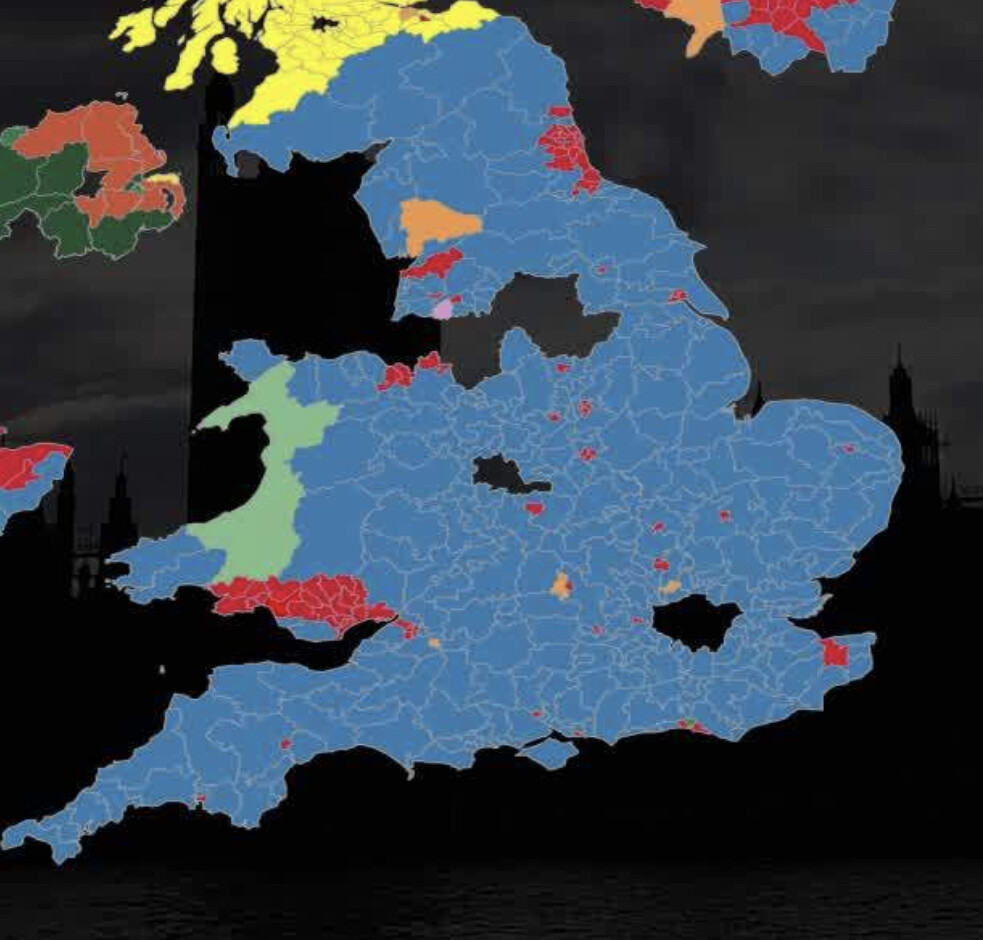
It’s not. Ordinary people living in “shires” love our shires and want to conserve their beauty, and conserve the natural environment. And we tend to vote for politicians that conserve.
Only in the London bubble would we be written off as a fringe “narrow interest group”:
If you want to make London even more crowded, polluted and miserable that’s your prerogative. But please don’t criticise politicians elsewhere who are listening to the people that elected them, and who are conserving beautiful parts of the U.K.
You visited a run-down outer borough of London and cherry-picked an ugly piece of green belt land to photograph.
You used this anecdote as the basis of an opinion piece to promote building housing over green belt land to further your two tier housing policy.
The effect of your policy, aside from concreting over precious green space, is to artificially reduce prices for some residents (mostly Labour voters) while increasing prices for everyone else.
@PV erroneously stated that it’s developers that fund affordable housing. It’s not. The cost of building these houses is actually passed to us - the taxpayers who are only allowed to buy the more expensive tranche of housing from those developers.
Luckily, since you’re a London politician you have little power to concrete over our green belt. You are a safe distance from the areas of outstanding natural beauty that exist in Tory-voting “shires”
Source please? Could it not be the case that the cost is sucked up by the developer as a condition of the planning process and that the sale price of the accomodation is largely set by the wider market? I doubt that if these conditions were disapplied the developer would generously cut costs of their other properties.