Thames Water recently sent a person round to the house to ‘audit’ our water use and suggest changes (the Smarter Home Visit - http://www.thameswater.co.uk/metering/17037.htm). It turns out we were doing pretty well (20%+ below average), but they still gave us some ‘tips’ on saving water, and money. Apparently we could save water by using a basin to wash dishes instead of the sink.
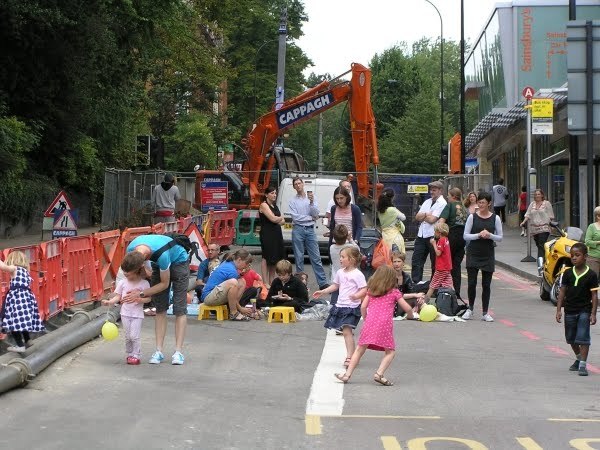
Yet all this time, this leak on Dartmouth Road has been wasting as much water in a day as we probably use in total in a week. This has been going on for months (hence the damage to the tarmac).
Seriously? Don’t you think it would be better to get your act in order and fix the ageing, and decaying, infrastructure before telling others what to do?
I do agree we should all do what we can, and improve our habits, but individuals need to see the companies making the same (or greater) effort.
Totally agree Rob, there are some leaks you see that have been going on for so long, moss is starting to grow on the paving around the area.
Seems, just like the gas network too, that patching up the old stuff has reached the end of its life, and some proper replacement of their networks are in order.
Perry Vale alone has seen numerous gas repairs over the past few months.
But the water situation is dire now. Their tweet a leak service is very good at taking action, and their website is OK at updates. However it would be good to see some long term solutions, rather than the Band Aid approach.
London Road as well, the lower section by the lights, and of course the bit up by Hornimans on the hill, where every few years it gives up and has to be repaired.
Certain areas such as London Road just need a top to bottom replacement now. Otherwise every time a new modern patch is put on, it causes more pressure and weakness on the older infrastructure.
The local water infrastructure is dated to say the least. Honor Oak Road is particularly bad. A water contractor told me that some of the piping is pre-Victorian. It has been patch and mend ever since it seems. It amazes me that this makes fiscal sense for Thames Water.
Does seem bizarre that they continue that way. Would be interesting to know the official line on the matter, but bet a lot of it is due to the scale of the job and subsequent disruption.
A plumber working on our house said that neighbouring roads had lead piping right into their homes, which wouldn’t be allowed by modern standards. It’s certainly very “authentic” in Honor Oak Park.
… and the thing is that this is not the first time this has happened to the same part of Dartmouth Road in the last few years. They have done some major work on that particular part of the road recently, so either they are doing a really bad job at repairing or replacing Victorian pipes with Victorian pipes…
No, absolutely. I used to live pretty much right there (above Doopo Doopo or whatever it is now) and there was one total replacement of the main supply and about four big leaks in the five years I was there. It’s almost as bad as London Road at Taymount Rise.
Sadly most are these days. They either don’t last or the road falls apart shortly after.
Surely when a utility service digs a hole, it is THEIR responsibility to return the road surface to a usable and lasting condition, and not one that will fall apart in days.
I have been wondering for years why local authorities don’t chase up the contractors. Or is it just a “do as you please” thing?
you are correct, utilities are obliged to repair the surface to a comparable standard as that dug up, however they don’t necessarily have to do that straight away, they can make a repair which is ‘good enough’ and have up to 6 months to make a permanent repair to the required standards. local councils can and do go after utilities where the repair is unsatisfactory, but it’s often a case of too few officers working over too large an area. in cases like this it’s often worth contacting the local authority to point out something like this, and get them to send out a streetworks inspector. If it’s Lewisham, then email Highways@Lewisham.gov.uk they’re usually good at replying.
local council can also do core samples of patches, or repairs to check what subsurface materials are to check that repairs have been done to specification. This can result in fines, and/or re-doing the work.
Thames Water really are not great at fixing leaks.
[Edit to add] - just checked with a colleague to ensure that what I’ve said is right, and it’s broadly accurate. Most utilities will put a permanent reinstatement in within a week, if they can’t they have to advise that it’s an interim reinstatement, and then they’ve got 6 months to make permanent, but any reinstatment must be up to a high enough standard that it doesn’t disintegrate, or break, etc.
Hey @Jon_Robinson Thanks for such a detailed reply, that clears that up then. I will make a point in future of noting when jobs are completed and see if they go bad. Some utilities companies are amazing at such repairs, and once done, its like it was never done. Hard to understand why others are so poor, when clearly the techniques are in place to make good repairs.
But as I say, now armed with the knowledge, I and others annoyed by these practises can start making a bit more fuss about it