I cycled home up Court Lane last night. They’ve put planters down at the Dulwich Village end and closed the road. It was wonderful. No diesel fumes and not one single car on the road. Made a nice safe change from the usual overtaking and being pushed off the road by people in SUVs.
4 Likes
The Court Lane closure HAS had a knock-on effect to College Road. When I was driving back from work the other month the congestion along there was awful - at a standstill for 10minutes, never seen traffic that bad in the area and definitely didn’t resemble the Dulwich Village I recognise. I actually thought about how it was creating more air and noise pollution for the leafy area.
I really don’t think closing off roads in one area and displacing it to another, bringing traffic to a complete standstill in multiple directions really achieves the air pollution reduction that they are after. Beneficial to pedestrians and cyclists? Yes. Beneficial to air and noise pollution to local residents and the area? Very doubtful.
2 Likes
This has been discussed a lot above, but I think that in the short term more congestion on other roads is an accepted downside. But longer term the scheme aims to get some of these people who are popping to the local shops in their SUVs looking at how fast Clausy is going on his bike and deciding to give it a go themselves. The aim isn’t to hope that traffic just keeps moving on fewer roads, it’s to effect behavioural change. There are some stats used above that suggest this is a beneficial aim, less than half of Lewisham residents own cars, and a large proportion of car journeys are only a couple of miles - if even a fraction of those journeys switch to bikes or walking then the congestion could start to ease with fewer vehicles on the road overall.
4 Likes
Agreed. But this was during rush hour, this wasn’t people nipping to the shops it was most likely people like me who were driving to/from their place of work.
I am now getting public transport because the traffic has got so bad but for people like me, who don’t have the luxury of WFH, public transport felt very unsafe at the beginning of lockdown. There was no option but to drive to my place of work which is on the other side of London. It’s too far for me to cycle and walk, and if truth be told London motorists terrify me too much to cycle as well.
The aim of encouraging people to cycle/walk more might be the motive but that only really works if it’s practical for people to be able to do that based on their journey distance.
Whilst I’m happy that cyclists now feel safer on certain roads and have more space it’s a lose-lose situation for a lot of commuters who are not WFH who either have to face busy public transport with people not wearing masks or sitting in hours of traffic in their car.
I personally think IMPROVING the roads to facilitate cyclists is much better than closing them.
4 Likes
I agree there will always be people who need cars and busses etc so it is important roads work well for all types of vehicles and I think that’s the plan, there have been some really good bits of cycle infrastructure built in recent years with more to come.
2 Likes
Also adding significance to Mayow Road is the new Brent Knoll school which is due to be rebuilt, see New Brent Knoll School site planning application
The Silverdale/Bishopsthorpe closures do seem somewhat at odds with the aims of the announced, but yet to materialise, plans for school streets.
Maybe they will close Dacres Road next? 
Schools that cannot take part
Unfortunately, schools with entrances on A-roads or B-roads (for example the A205 or B218) are unsuitable for closure as a school street. However, these schools can still take part in the school travel planning programme and other initiatives.
Dacres Road (Fh Boys) is unclassified, so they might try to close it.
Thorpewood Avenue (Eliot Bank) is unclassified and upper Kirkdale (Kelvin Grove) is CIII. They could be closed, and if they are would obviously have to be both done or neither. But that means all traffic diverted past Holy Trinity (Dartmouth Road - A road.)
And no school buses.
And of course no chance of getting to work for those who aren’t lucky enough to be able to ride cycles or can walk to work or work from home.
We have very few non residential roads in this part of the borough - I cant think of any. Even Willow Way is having a big residential estate built on the site of the old police station.
1 Like
I haven’t heard many calls for Dacres Road to be a school street. I get the impression this is more aimed at primary schools whereas we expect our boys to take public transport or walk to secondary school.
I would see closing Thorpewood Avenue and upper Kirkdale as being totally independent of each other.
Upper Kirkdale, seen by many as the Forest Hill Bypass is probably seen by the council as a primary route for cars, bicycles and is served by the 356 bus. The current Mais House development will probably make the road a more important route especially if/when construction starts. It would be difficult to close this without major implications for the whole area.
Thorpewood Avenue is a more residential road with no buses but with 2 primary schools. It is probably a better candidate and would benefit the forgotten Holy Trinity kids who have their main entrance on it. I doubt though you will get the local residents to agree but you will probably get most opposition from the schools themselves as they want free parking for their teachers.
I blooming well hope not! By that thinking a lot of people probably think of Thorpewood Avenue as the Kirkdale/Sydenham Hill roundabout bypass.
Upper Kirkdale is an entirely residential road. There aren’t any businesses on it at all. Unless you count Kelvin Grove School as a business.
Children cross upper Kirkdale to go to Elliot Bank and obviously closing Thorpewood would make upper Kirkdale even more dangerous for them as well as the Kelvin Grove children.
I didn’t make it up just passing on how people refer to it.
Kirkdale has an interesting past and despite attempts at referring to it differently for different parts such as Kirkdale Village the middle bit and upper Kirkdale for the hilly bit, most people just see it as Kirkdale, a very significant link road that gets you from Sydenham towards Dulwich avoiding Forest Hill. It would be very hard to close any part of Kirkdale without affecting the other parts although I can understand why you would be in favour if you had a business in the Village or a house in the upper part.
I do cycle on Kirkdale regularly and dislike the level of traffic but accept that what might be good for me would probably be bad for others and on balance closing it would be a bad idea.
I am not in favour of closing the top of Thorpewood. I would say though that during school time, the excess traffic using the junction with Kirkdale makes it more dangerous than normal and removing that traffic would make it a safer junction but it would be using a sledgehammer to crack a nut.
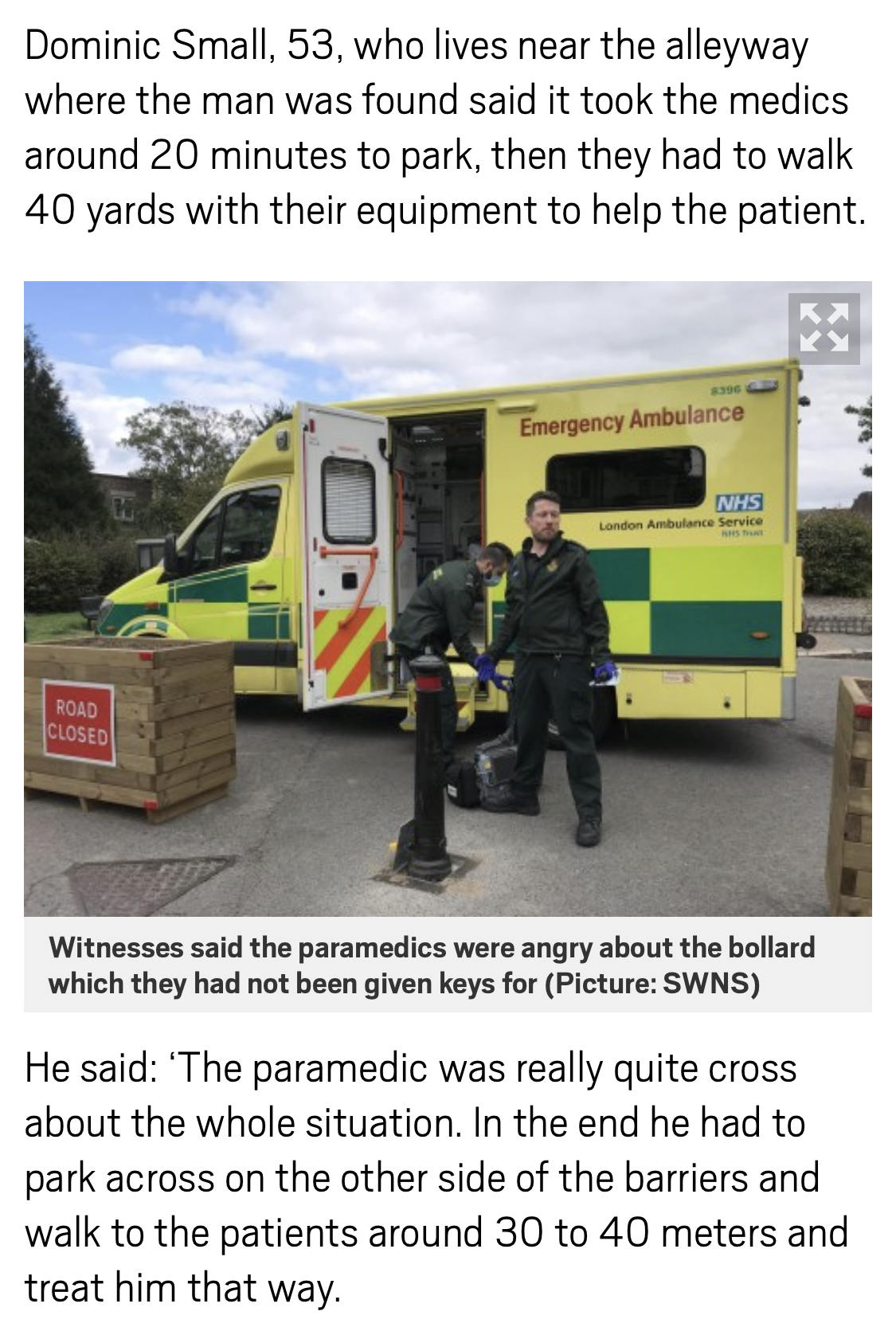
20 mins to get to a man 30-40 meters away 
Is there a name for it when one takes a valid argument and then exaggerates it so much it weakens the original argument?
2 Likes
Nope, 20 mins to park, and then they had to go back and forth 40m on foot to treat the patient, rather than being able to park next to him.
I expect they encountered road blocks and tried to park elsewhere, but in the end parked by the bollards
First paragraph says “Paramedics were delayed from treating a patient by 20 minutes”
I skim read article - seemed like they were obfuscating what happened. My question on the exaggeration was genuine - it’s something I see often.
The whole article is all over the place. Later on it says
“London Ambulance Service claimed they reached the first patient within their target of 18 minutes for a category 2 emergency call.”
Also if they’re really in a rush they’ll literally park in the middle of the road. I doubt they’d ever drive around for 20 mins looking for parking rather than walking 40 yards - that sounds like some kind of random anecdote. Must have been at least 20 mins guv.
It sounds like it’s the council’s fault for not issuing keys and updating the emergency services properly - they should know exactly which roads are closed and where.
Might be poor reporting by the Evening Standard, here, but I think it’s clear that the bollards hampered the ambulance. We could argue all day as to whether this created a delay of five minutes or fifteen minutes.
The critical point is that a delayed ambulance, even for sixty seconds, will mean the difference between life or death.
Imagine if this were your mother or father dying on the street while an ambulance driver fumbles around looking for keys to a bollard (potentially multiple bollards).
Imagine how you’d feel in the ambulance, clasping the hands of your loved one, light fading in their eyes, as the driver stops to unlock and put the bollard down, gets back in, drives through the gate, stops again, gets out to put the bollard back up, locks it into place… then reaches another bollard… etc…
 Glad you asked, I’d think:
‘Although my time on this fine earth is coming to a close, I’m glad that I lived long enough to see these safer streets measures introduced so future generations can live healthier, happier lives.’
Cue Brian Eno track playing me out. Camera fades to black.
5 Likes

The problem here is not the road closures, which have good aims, but the lack of co-ordination and care in rolling them out.
Neighbouring boroughs were not consulted, signage was inadequate and lead to drivers getting caught in dead-ends, planters and bollards were not correctly spaced to prevent people bipassing them and emergency responders have been needlessly disrupted on more than one occasion.
All of this just generates needless friction and further polarises opinion on what could have been a lot more positive and beneficial if managed with more care.
2 Likes