… and yet neither would require the word premature in a headline 
Anyway I wasn’t aware that City offered sky diving tours. This would be a great way to get home early.
“Drop me off over Forest Hill captain, eh?”
… and yet neither would require the word premature in a headline
Anyway I wasn’t aware that City offered sky diving tours. This would be a great way to get home early.
“Drop me off over Forest Hill captain, eh?”
Eh? they don’t.
I am also sceptical about this data, but the story is about noise pollution, and the fact that - compared to the efforts to deal with particulate pollution - almost nothing is being done, ESPECIALLY IN LEWISHAM.
This is my point, it is the article that refers to the questionable air pollution data. Why use questionable data to illustrate a point you (the journalist) are trying to make in a piece? What advice would you give Lewisham council to start tackling the problem?
They could start by offering the same level of noise enforcement protection offered by other (equally broke) London Boroughs.
You are aware that the council can’t deal with complaints about, aircraft or rail noise and traffic noise on the public highway? So in general we would be talking about noise coming from commercial and residential premises, have you got examples we could give to the council to investigate?
In regards to noise from residential properties, I don’t think there is a way the council will address this if it’s a one-off issue. There is no number to call, just a form to fill out with an aim to contact you within 48 hours. Essentially if someone is still creating noise on a one-off occasion at 4am there is nothing you can do about it.
The council advices you not to speak to your neighbour about it until after it has finished…
It’s another area where anti-social behaviour is in effect no longer policed unless it occurs on a very regular basis. I assume within the council’s budget, it’s not deemed a priority, or important.
I’ve always assumed premature refers basically to passing away before your expected life expectancy. So any factor that leads to you dying before this expected age contributes to a premature death. some of those factors are preventable (eg some health conditions due to diet, smoking etc), others are preventable but need group change (eg pollution, air quality) and some are simply accidents, some of which may be preventable (enhanced Health and safety etc).
That’s what I thought, so how we can define what influence other factors, apart from very obvious ones like your parachute not opening have on the timing of our death is nearly impossible to quantify.
Well I’m guessing here, but I assume you look at data and make conclusions. Nothing is is 100%, but I guess an obvious example might be that smoking might cause a premature death.
So you take 1,000,000 people who smoke and 1,000,000 who don’t and compare stats. Clearly you would also need to cross reference with other factors, and you might say 2,3,4 factors contributed but you can start to see things that have an affect.
So you do the same for people who live in areas of high pollution, and whatever other factors (I assume some / most of this is done in reverse, ie you look at people with premature deaths and look for similarities in lifestyles etc and see what common factors come out). That might not always conclusively tell you why a person died prematurely, but it will show that many people that die prematurely are exposed to X, therefore X should be addressed, and where it is, does it have an effect on life expectancy for people in that group.
Someone brighter than me will hopefully be along shortly who actually knows what they are talking about!
There are different ways of dealing with things. For example, the Council apparently wrote one letter in response to the original consultation about the London City concentrated flightpath which is now disturbing their residents in Catford, Forest Hill and other areas. They did not follow up. Instead of being passive respondents they could have advocated for this not to go ahead. We have a Lewisham Mayor, a Council, a City Mayor, local MP and GLA reps all from the same Party. They could have worked together on a campaign to stop this happening. But nothing was done. This is the point of the article: lots has been done to reduce air (particle) pollution, but nothing to reduce noise pollution.
Yes, the Council does not have specific statutory responsibility in respect of noise from aircraft, roads and rail. But that does not mean they should take no interest, they could still take noise measurements, so they have data to hand about what is going on. The Council does many things it is not legally obliged to do, and this should be something they are proactive about as it affects so many people. Don’t they also have an overall duty of care?
If you check back to the original post you’ll see that (at the FHSoc AGM) we got the Mayor to commit to engage in discussion on this topic:
Sadly I think it’s not due to lack of interest, the issue remains one of money. They may be ‘all from the same Party’ but the overall funding for local government is down for 10+ years and Lewisham’s budget is down from £400m+ to £240m and of that almost all of it goes on social care. There’s barely any money to do anything new, it’s mostly focused on keeping things functioning.
There are a couple of pollution meters dotted about, but no chance to get much new monitoring equipment installed at the moment. I have got a new contact in the transport department though and I’m going to try to get in touch with them.
Five years after the introduction of the contentious flightpath that directly impacts his constituents, the mayor agrees to think about representing their interests. Why so late? Why not pre-emptive and proactive?
No, the Council does manage to prioritise things for which there is no specific statutory responsibility or funding: for example there is no statute that says the council must have a “positive ageing project” or that Lewisham must be a “Borough of Sanctuary”. I am not suggesting that these things are not important, I am suggesting that if the Mayor and Cabinet were interested they could make resources available.
If you look at the Directorates and Structure of the Council’s Management Structure, Head of Environmental Health Services is low in the hierarchy:
I cannot judge whether all the roles listed are necessary and productive, but I am confident that environmental health services could be given higher priority. The Council could start measuring noise if there was political will, but there isn’t.
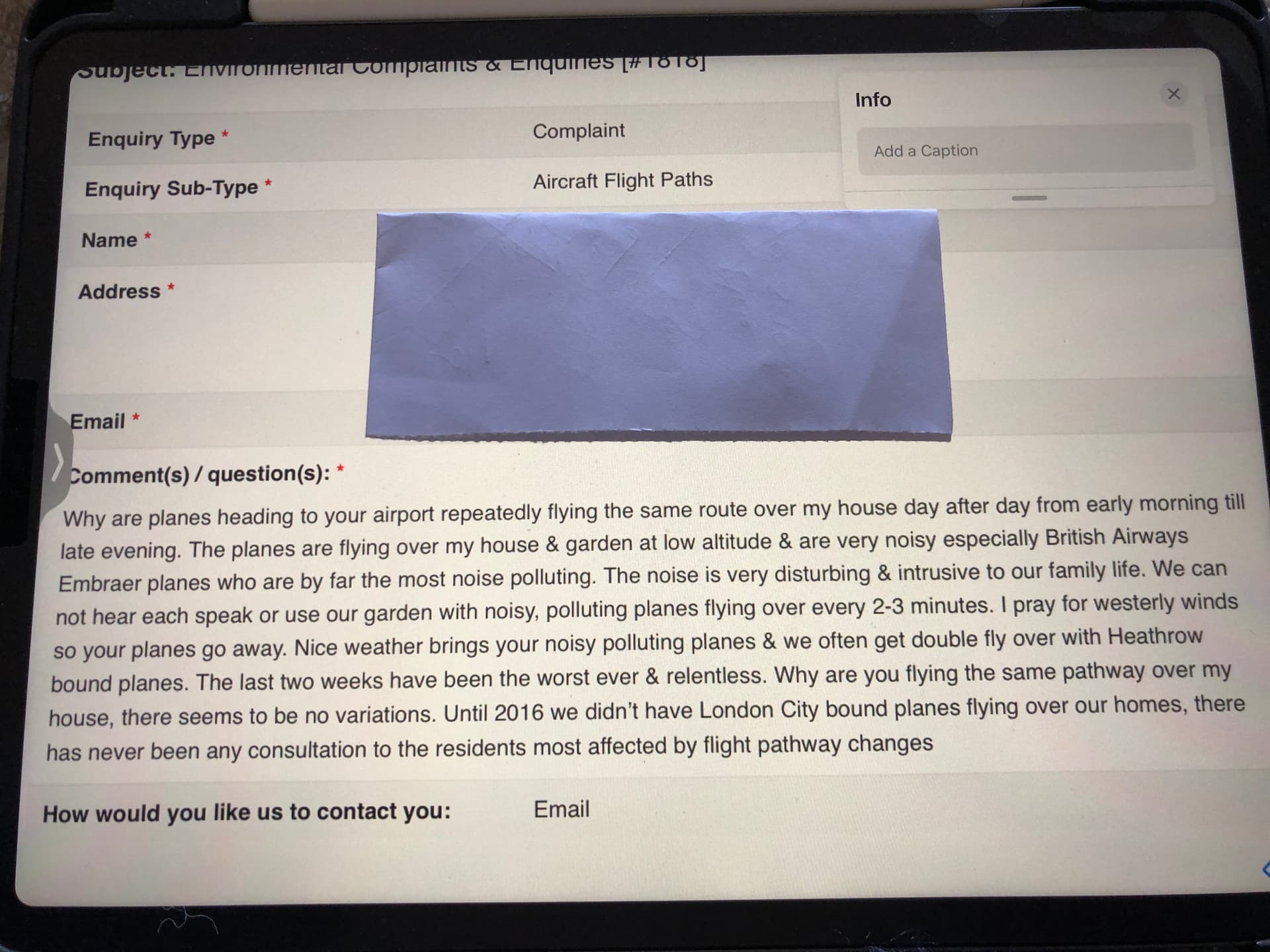
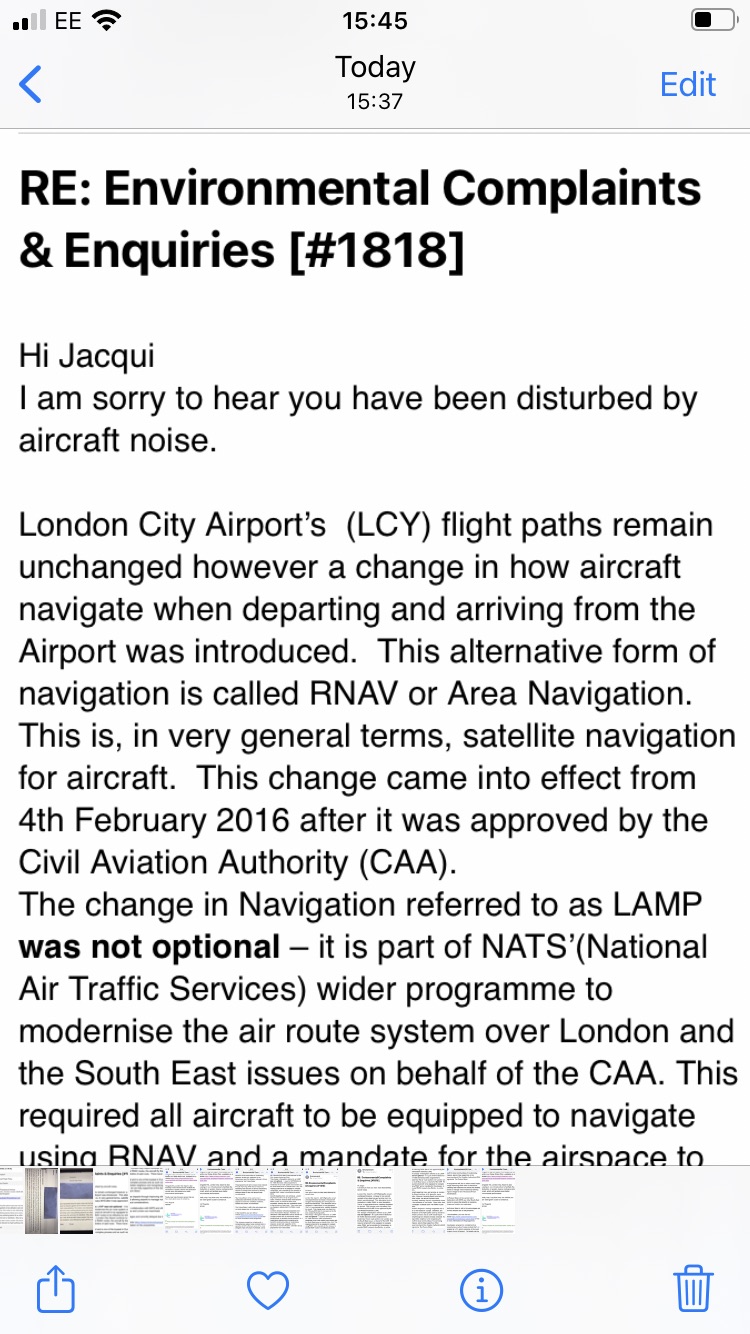
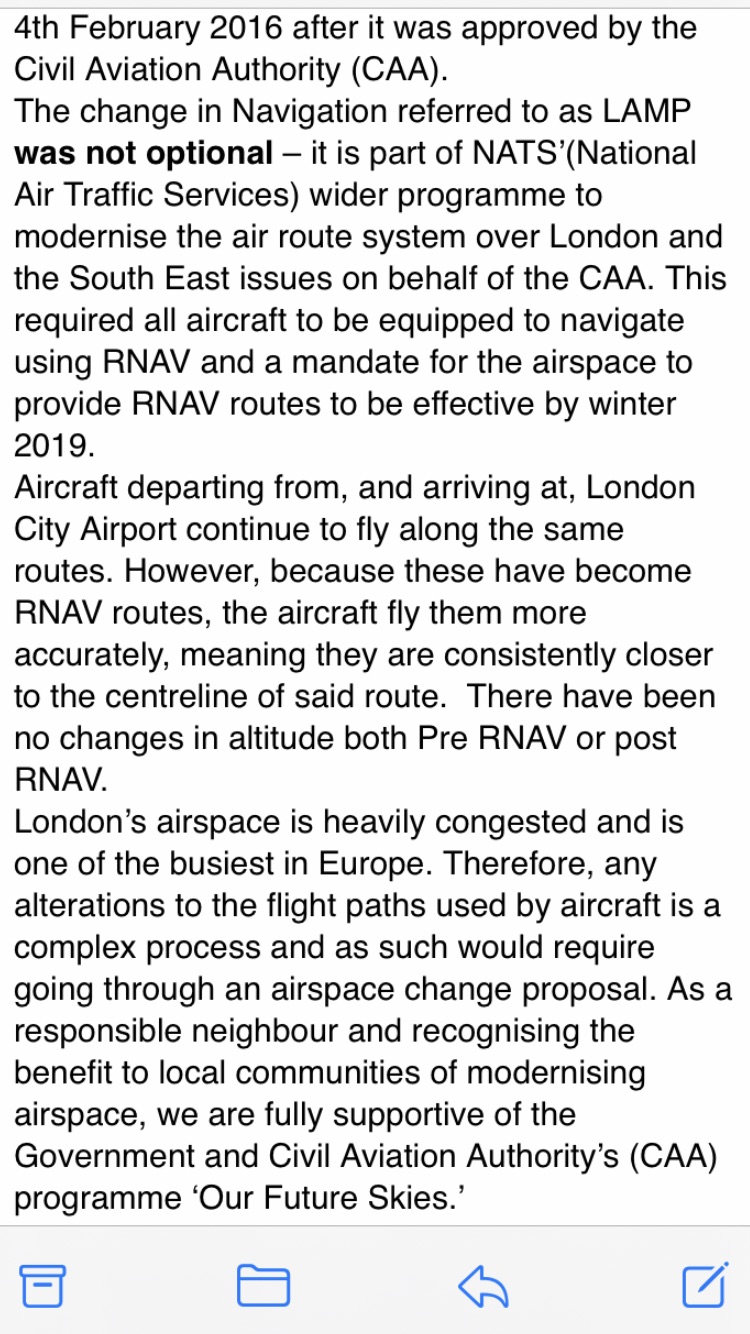
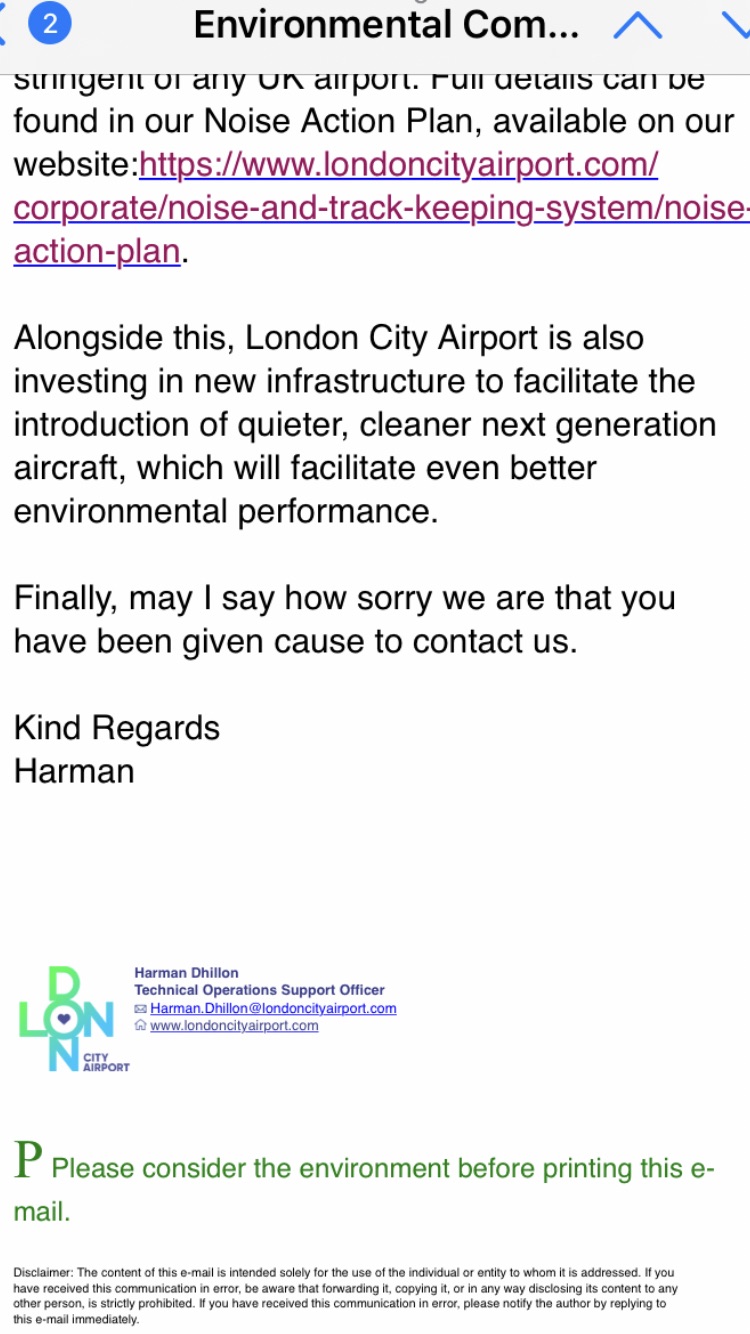
This is the reply I received this morning from London City Airport to my complaint about noisy flight pathways. Not the usual reply. Sorry it not the best way to send but could only use photos.
What BS! You know it’s unjustifiable when they start saying it’s necessary because they have to ‘modernise’ the route.
Flight Radar 24 offers Calibrated Altitude and GPS Altitude. It would be helpful if you could explain the difference. Is one regarded as more accurate, or are they measuring different things? The Calibrated Altitude for inbound LCY flights is frequently below 2,000 ft for aircraft flying over Catford and Forest Hill. I haven’t used flight Radar 24 for a couple of years, but checking in this afternoon, all flights are are below 2,000 ft over our area.
If I could I would  . What I can say is that the CAA , London City and Heathrow have all told me at various times that Flightradar24 is not a reliable source of altitude accuracy. Rely on TravisLCY for City and Heathrow’s own online tracking systems. Both take their primary data from what they see as accurate sources.
Both also have a historic tracking function, so if you see a plane that you’d like to measure altitude for simply backtrack on the relevant airport system to that time and watch the plane fly over SE23. If you want to prove to them a particular low height you can freeze the image and take a screenshot using their own system.
Not saying it’s easy, but I think using their own data avoids doubt or any wiggle room.
If it’s any consolation, just had a look at Windy.com, wind direction will change tonight, so should be free from the LCY arrivals for a week. However, we get the Heathrow 27s arrivals again.
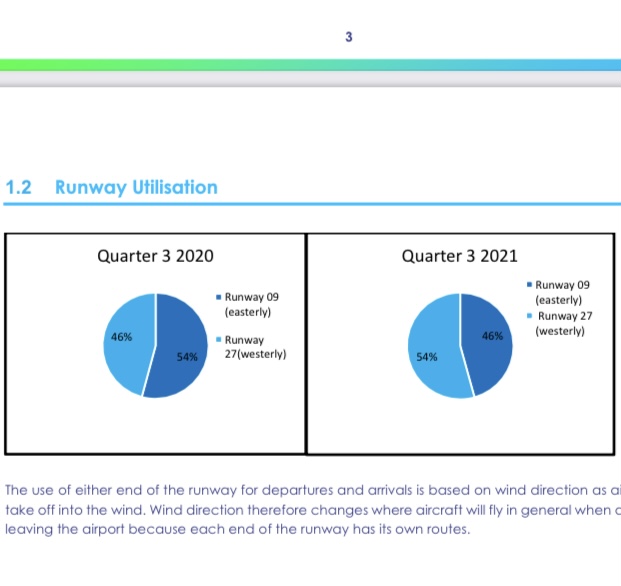
The runway utilisation % are reported accurately every quarter and are available to view on the Consultative Committee website. Search for LCACC.
The average % of easterly winds varies from quarter to quarter and the overall average figure from year to year. The figures are also reported in the airports annual report, available on their website.
But one of our constant complaints is that the average figures do not adequately capture that easterly winds often mean clear blue skies and periods of high pressure, which is often the warm spring summer conditions when we have windows open and use our gardens more.
One such period of around 2 weeks is just coming to an end.
Here’s an example of a quarterly report. In it you see that in some seasons the % is way over 30%. But the annual average might still be 30%.
It will be so nice to have some relief from low flying, noisy London City airport bound planes overhead every 2-3 minutes at times. Unfortunately Heathrow bound planes take their place when there are westerly winds at least they mostly fly at around 4,000 feet & are less intrusive. We often have both Heathrow & London City airport bound planes overhead at the same time, so double noise & pollution for us humans below. On one occasion last week, we had planes taken off from Heathrow flying overhead as well. All at different altitudes but a bit disconcerting living under all these aircraft flightpaths which weren’t there before 2016.