Proposal 1 to introduce banded charging for parking permits based on vehicle CO2 emissions and to introduce an additional surcharge to the cost of parking permits for diesel vehicles;
Another way to look at it is that the early adopters are paying over the odds for the technology before all the problems are worked out and scale of production makes electric cars affordable for all.
This is possibly taking a little to help seed the technology for everyone’s eventual benefit.
The more we can do to kickstart the EV ecosystem, the sooner all manufacturers will start participating, and thus prices will be driven down.
But yes, environmental subsidies can have a disproportionate effect on the poor.
Edit:@ForestHull’s post is spot on too. Tesla’s strategy is to sell expensive Model S vehicles and use the revenue to build mass production capability for affordable Model 3 vehicles.
All slightly ironic given that a parked car produces no emissions
While it all sounds laudable in theory, I can’t help thinking the council is jumping on the zero emission bandwagon to primarily generate some more cash. The emissions based aspect of the proposals only applies to permits for residents within CPZs - which means that the vehicles affected will all be cars that by their very nature, are parked on the street, which is not ideal for something that requires several hours of plugged into the grid to charge - and running a cable across the pavement is not really practical (probably a H&S nightmare to boot).
Yes - there are means to charge elsewhere, but the current infrastructure in the borough is no where near enough to cater for a large influx of electric cars just yet - especially given the number of times I’ve see non-electric cars parked in the charging bays at Sainsburys
I admit - all of the above is based on the assumption that fully EV cars are the only viable alternative, and I’m sure that various hybrids and even some very clean ICE cars that may well benefit from the above, but given the stated drivers behind the scheme - surely full EV is the councils ultimate goal.
Unfortunately - since Appendix 2 seems to be missing in the pdf, its difficult to tell if it will actually be any cheaper than it is now for zero/low emission vehicles, or just more expensive for everyone else.
I also wonder if you look at how much carbon usage there is to charge electric cars of the mayor would be so generous. Mind you there are no power stations in London so I guess he is not bothered about that.
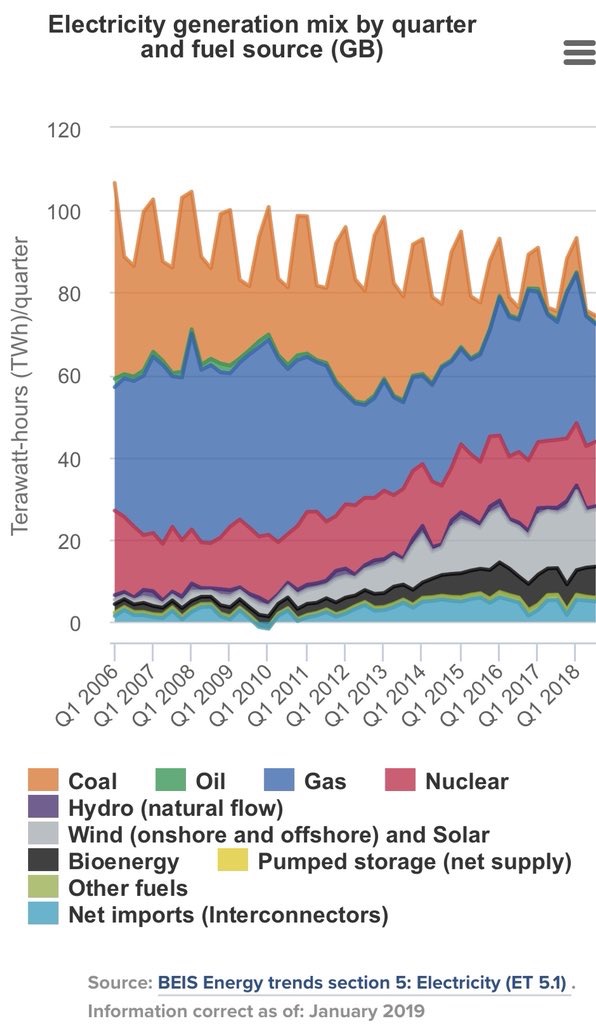
Also, with the UK producing roughly just more than 5% of its electricity I wonder how we will cope if there is a sudden uptake of electric vehicles?
Over the last decade, renewables have gone from negligible to 1/3rd of the UK power generation mix. And taking nuclear into account, more than half of UK power generation is now carbon-free.
Also, over the last ten years, coal power generation has nearly been eliminated - replaced with gas power generation, which emits less than half of the CO2
Question is, if we make the same leap with electric as we did with diesel in as short a space of time is there enough energy and infrastructure in place to cope?
There is one other significant change which is raising parking fines south of the South Circular to be equal to north of the South Circular which increases them by £50. This makes sense with the expected shift of parking to south of the South Circular with the ULEZ coming in.
There is virtually no controlled parking in Forest Hill so this isn’t going to affect many here but we do have a lot of commuter and other parking so it is a classic example of saying something that will do nothing. If they wanted to reduce pollution, they could reduce the cost of parking permits encouraging CPZs to discourage commuter and other parking and allow local residents to park on their street rather than forcing them to convert their front gardens to concrete driveways.
They are in an indirect way doing this by putting it in the North of the borough/North of the South Circular with the ULEZ.
It is not a congestion charge as such but a pollution charge but I am sure that when people have got rid of their very polluting cars, it will be switched to the slightly less polluting cars or perhaps just all cars. Residents south of the border will still get all the people avoiding this charge and finishing their polluting journeys here.
The money from ULEZ won’t go to Lewisham, and the residents of New Cross and Catford (for example) will not benefit.
Council Tax paying residents are an easy target. Lambeth and other Boroughs do the same thing: someone with an old car who lives at the edge of the Borough and drives to Sainsbury’s once a week will pay, whereas drivers who commute through the entire Borough every day will pay nothing.
It is predicted that pollution inside the ULEZ will decrease by up to 30%. I normally don’t believe experts but with a £12.50 daily charge, they will probably be right this time. The people in Catford and New Cross will have less pollution so they will benefit.
I agree the border people will suffer both when they have to travel and when more people drive in their area.
There is a consultation on the Lewisham website about this, closes 26th July.
[one of the few pages that is working today on Lewisham’s website, most things there have Error - page unavailable]
The poor are also disproportionately affected by the ill health caused by pollution and climate change. So they do benefit from the wealthy paying for less polluting vehicles.