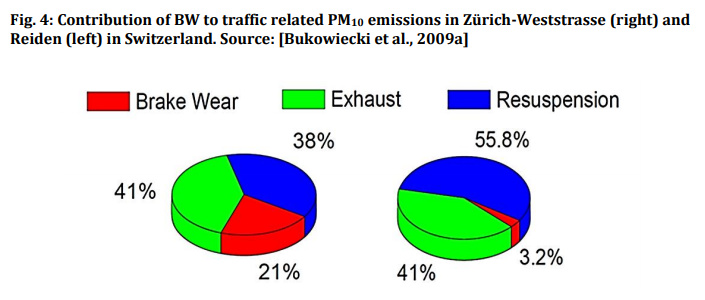
Regardless of the relative health implications - given that ~40% of particulate matter comes from the combustion in the engine, moving to EVs should help see a significant reduction in those emissions as well.
2 Likes
May I suggest that in a highly congested city, such as London, the emissions from stationary vehicles is likely to form a larger percentage of pollutants. For non-congested areas, with less time spent stationary, the pollutants from engines may form a proportionately smaller part of the pollution (but still high).
Professor David Begg said:
“Congestion dramatically increases carbon dioxide emissions from vehicles.
“Under heavily congested conditions tailpipe emissions can be increased by a factor of three or four times.”
Based on this hypothesis it is useful for major cities to switch to Electric vehicles which can sit in traffic jams producing zero pollution. Even when they go slowly (and it is rare in London to get up to 30 mph), most of the pollution is likely to be eliminated by Electric vehicles. Even switching from diesel to petrol will produce some small benefits.
4 Likes
Good point @Michael.
On an unrelated note I just read that this new tax on polluting cars is so costly to implement that it won’t actually make a profit.
Bit of a pity eh?
Seems they should have just tweaked the existing congestion charge. But that wouldn’t have won such prominent PR for Khan…
Where does it indicate that they could have tweaked the existing CC?
Also it actually does say
Mr Khan has launched the T-charge to tackle London’s air pollution and prepare the city for the introduction of the ultra-low emission zone, which he plans to introduce in April 2019.
He said the ultra-low emissions zone would “bring in revenues and that revenue will be ring-fenced to improve the quality of air”.
So they will eventually make a “profit” which will be used to help air quality.
I’m sure there would be just as much criticism if the scheme was making a profit.
I wonder how much money was wasted extending the C-zone and then reducing it back down? Possible much more than £7m
I wonder how much higher the charge would need to be to make a profit? No doubt it will be increased to reach this level, or possibly extended to the additional 100,000 taxis polluting central London. You could probably argue that London taxpayers and subsidising the exemption for mini-cabs.
I think London and the Mayor’s office should be commended for their efforts. They have taken a lead in the UK where other cities were meant to follow. Back in December 2015 the Government announced plans to create Clean Air Zones in a number of major urban centres like Birmingham and Leeds. London was excluded from these plans because London was already ahead of the curve.
In London the Mayor has a well-developed strategy for improving air quality by 2025, including the implementation of an ultra-low emission zone by 2020, retro-fitting of buses and licensing new taxis to be zero emission capable from 2018. We will continue to support and monitor the delivery of the Mayor’s plans.
Unfortunately the Government didn’t follow through so it’ll be likely down to individual urban authorities to create policy and lead the way. They can look to London for innovation.
I’m sure I read in another article (may find it later) that the number of affected vehicles dropped from 10,000 on the announcement of the t-charge to around 6,500 now. A success before it even started? In the same article I’m sure I read that the Mayor intends the t-zone or low emission zone to be bordered by the north and south circulars, so possibly more than the congestion zone?
Changes the dynamics of the right and wrong side of the tracks for Forest Hill
1 Like
If you live inside the S Circular, own a vehicle that is considered sub-par, and have to drive into central London, I assume that you will get a resident’s discount. The worst affected [financially] could be those that live just outside the S Circular and have to venture inside every day, e.g. to drop their kids off at school.
We will have the Forest Hill Sainsbury’s car park inside the ULEZ, so I’m unsure how business will be affected - will people drop into the Forest Hill co-op instead?
Finally, will the 2019 ULEZ render the Devonshire Road access thread redundant?
1 Like
Actually good point.
I recall William Rose Butchers used to be on Kennington Lane in Vauxhall. When the congestion charge was introduced they were right on the border… the charge side for them. Which meant their many customers who drove and parked in the streets around them were paying the charge. So they moved.
Though I would think the move to ED was good business sense too.
The solution is lighter vehicles, specifically motorcycles.
There. I said it.
3 Likes
With four wheels, covered, a mini bar and a driver.
Just make sure you buy a Christmas miniature selection box before getting on the bus and you’re more than halfway there.
4 Likes
I think this is an interesting insight as to why the ‘stick’ approach of penalising car journeys is favoured:
Hopefully the ‘carrot’ side of this, i.e. improved public transport infrastructure will happen too (Bakerloo, CrossRail 2 & 3 etc).
1 Like
Charge me what you like - I won’t swap my petrol car for a diesel bus anytime soon, sorry 
Not even if bus routes were altered to suit me, or if they became more regular. Or even if they became free.
I drive for the convenience, because I often carry lots of stuff, and because I loathe public transport with a burning passion.
I reluctantly caught a bus the other night when trains were screwed and I travelled back to Crofton Park instead of Honor Oak. After a couple of stops, the bus driver suddenly announced he was changing route, everyone groaned and half the bus emptied out. Similar things have happened before, the few occasions I’ve used busses. Really cannot be bothered with experiences like this - especially not on journeys to Landmann Way or Bell Green, carrying heavy loads.
Fleecing drivers with higher charges will not change minds like mine - it will only hurt low income residents and small businesses, who will feel the effect of the charges acutely.
Strawman argument.
The point here is what has been found to work re cutting pollution. And occasional journeys to the tip are not really relevant either. I suspect you don’t drive to work so your behaviour is already being shaped. 
3 Likes