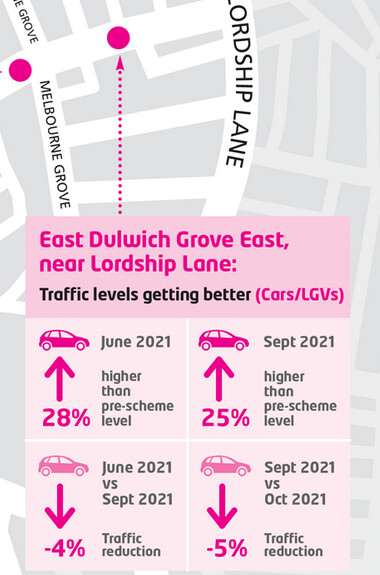
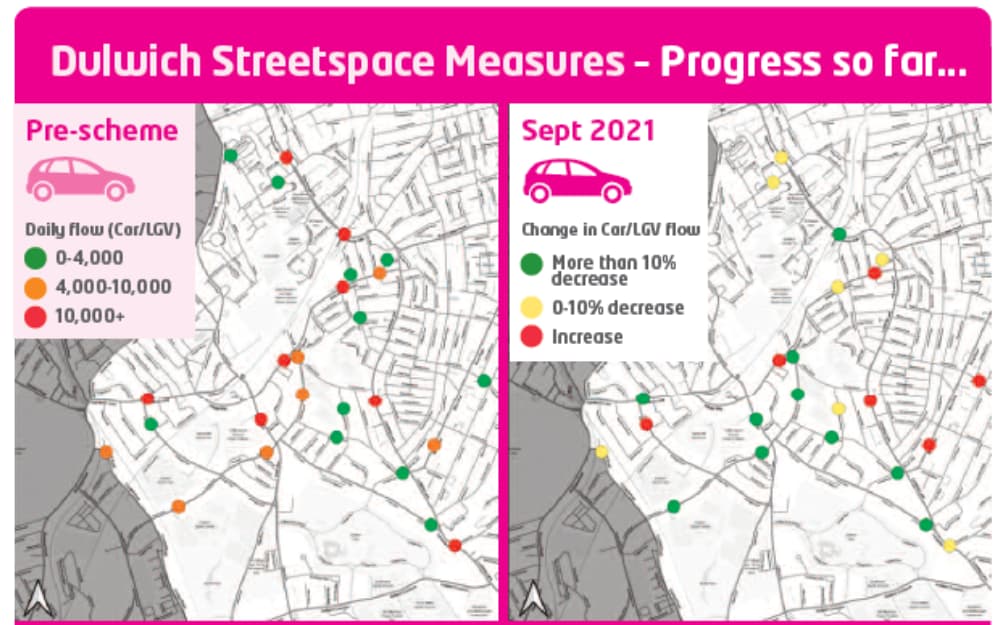
The validity of these figures are being discussed continually on the East Dulwich Forum. It would appear that even local Councillors in favour of the LTN’s have stopped quoting them as the data collection methods have been, shall we say ‘questionable’
As an example some of the data was collected during the fuel crisis in September 2021.
I wouldn’t trust those inforgraphs - not that I have any particularly views on the Dulwich LTN. But the monitoring points did not include Lordship Lane section where there are shops or the South Circular.
And there are monitored places where traffic has gone up by over 25% compared to pre-scheme levels.
Anybody living on these roads is likely to experience increased levels of traffic and pollution. I doubt there are any LTNs that do not shift pollution but that is generally a secondary consideration to the safety of pedestrians and noise from cars rat-running in more (and narrower) residential streets.
I think very few of the people who were consulted trusted the Infographics. The consultation was approximately 2 out of 3 against the LTN asking for it be returned to the original state.
The summary of the results tries to accentuate the positives but can’t hide the fact that it all comes down to winners and losers. Perhaps Southwark and Lewisham could learn from the ULEZ about what benefits us all is generally supported by all of us.
Summary of results
the majority of respondents opted for the response in each case that preferred to ‘return it to the original state’. This is true both for residents of the consultation zone and outside, however it masks considerable differences between views on individual streets – in most cases, residents of those streets with traffic filters were in favour of them being retained.
Key themes from all responses, also reflected in meetings and emails received:-
Concern about displacement of traffic and pollution onto other roads – in particular Croxted Road and East Dulwich Grove
Inconvenience and time added to all car journeys, both for people within and travelling through the area
Difficulties for older people and people with disabilities in accessing appointments and maintaining their regular activities in particular, though residents with blue badges within the scheme area can have exemptions to the timed closure, this was regarded as unfair to other disabled residents
Difficulties for parents with the school run, particularly those with children at different schools and/or needing to get to work
Relative lack of effective public transport options, and effects of traffic on some bus routes
Concern at loss of access for emergency services
Unfairness and unpredictability of fines issued at camera-controlled closures – signs felt to be unclear
Timing of camera-controlled closures leading to traffic build-up and affecting local businesses – many people felt that these should operate for a shorter/different time and/or only during school term
Difficulties for friends, family, health care visitors and tradespeople in accessing the area
Increases in congestion, standing traffic and pollution on some streets, including some with schools
Concern at safety risk for pedestrians where sharing the road space with cyclists
We received 7,542 responses to the survey. Of these 209 were voided as being duplicates (people providing more than one response). Of the remaining 7,333, some 5,538 identified themselves as living or working on streets within the consultation zone.
We operated a ‘unique identifier’ system with numbers available either on the envelopes that the newsletter came in or in the emails that were sent – however only 1491 responses included anything in the ‘unique identifier’ field, and many of these were incorrectly used – therefore this metric has not been used in the analysis below.
Interesting.
Almost 2000 people who don’t live or work within the consultation zone let alone within one of the schemes commented. That’s more than 25%. And only 20% of people managed to confirm their Unique ID. It seems to suggest a lot of people from outside could have been encouraged to submit responses i.e a nice internet pile on.
Interesting takeaway though is that people who live within a scheme approve of it, and people outside the schemes don’t want their roads closed, so it seems like everyone should be happy
I suppose until things return to near normal we won’t know if people return to public transport let alone demand destruction from higher fuel prices. It’s quite hard to benchmark to be fair.
Also worth noting behavioural changes take time.
Seems like the short term winners have been the lawyers who recently recommended against any further legal challenge in the High Court but presumably got paid for that opinion!
It is indeed obvious. What’s more interesting is that people who don’t live in LTNs seem to not want their roads open only for local resident access. Therefore they should also be happy in theory - so why aren’t they winners too? Why is it only those inside the LTN who are described as winners?
Conversely do you think they’d change their mind and consider themselves winners if they could be inside an LTN, once they experience the benefits?
I was thinking the other day there is not one single thing on the roads off Devonshire (Ewelme, Tyson etc.) that discourages traffic / promotes walking or cycling, so I think this sums up this area perfectly.
The cars parked on both sides of the road discourage me from driving along these roads. If you want to encourage walking/cycling, I’m not convinced some of the steepest hills in the area are the best place to start.
I think sometimes people mostly walk because they find a better route, they don’t need to be encouraged or discouraged.
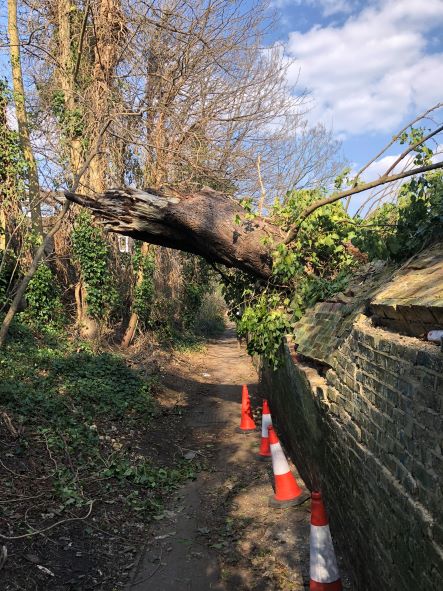
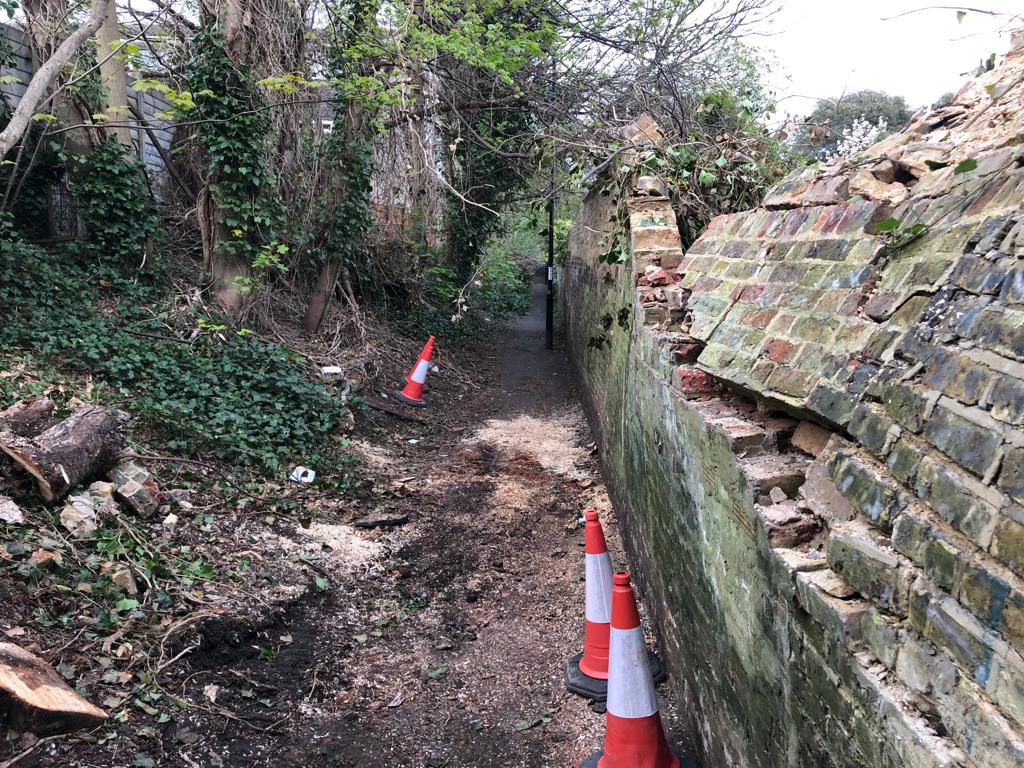
One example of this is the footpath that leads between Thorpewood/Derby Hill Crescent and London road opposite Sainsburys, used by locals to go to the High Street and kids to go to Eliot Bank. It seems a shame that it has now had an overhanging tree for about four weeks. Would the same be tolerated on a local road?
This lack of attention and maintenance on routes not used by cars discourages walking.
I rather suspect that this delay is due to the insurers of the council and the affected property arguing over who should pay a) to remove it and b) to repair that very expensive looking wall; plus the difficulty of getting equipment close enough to lift even pieces of it.
Meantime it shouldn’t discourage people from using the footpath as it rests above head height.