That’s good if you’ve found that you don’t need to use your car frequently.
But it’s not for you (or anyone else) to tell us that we should behave in the same way as you do.
All our situations are different.
That’s good if you’ve found that you don’t need to use your car frequently.
But it’s not for you (or anyone else) to tell us that we should behave in the same way as you do.
All our situations are different.
No one should tell you you must behave like me, but it is legislatures jobs to govern, as DfT have done in this case with their advice to local authorities, which Lewisham council seek to implement.
I know you dispute the consultation, but I remain content that the council are acting in the interest of their residents here accepting that might be at the detriment of some residents, some of the time - if there were cost free wins here being ignored then I would be disappointed, but what are they?
These policies would:
I think we’re rather far apart on this, as is tradition, so I’m going to practice what I preach and have a lovely cycle over to telegraph hill for a pizza in the park. Will be there 25% quicker than I would be in a car, and get to to further tone my great legs.
To quote the post prior to your rewrite:
Here’s my #1 solution: Stop pumping money into increasing residential density in London - especially local authority / housing association projects.
This would save the council a TON of money, and it would reduce congestion, pollution and pressure on local amenities.
Yes, everyone who’s not on the ladder would like other people’s property to be devalued by the building of more housing. However, I’m baffled by those who look at this city and think “needs more buildings”:
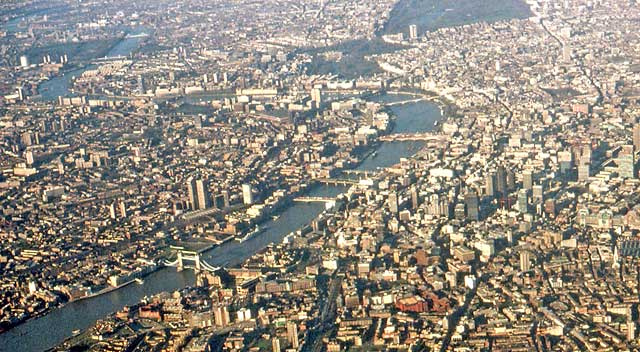
Sorry that wasn’t supposed to be a rewrite, I’d intended to reply to my own reply but I think reloading the page reloaded the editor pane I stead of reply pane or something.
Rat runners. Rather an insulting term for drivers trying to get from A to B in the most efficient way. We have problems in South London caused by our overground railways cutting streets in half and creating cul de sacs. That means we have fewer through roads and need to use the ones we’ve got, not funnel pollution (noise and air pollution) down a few “avenues”.
Which are these avenues by the way? Those who are unlucky enough to be singled out for this treatment ought to be told. We know Dacres Road is one. As are Mayow Road and Sydenham Road (high street). Assumedly London Road and Dartmouth Road are too. Heaven help those who live, work or study on those sacrificial “avenues”.
@PV we get that you have legs. That’s nice for you. I also am lucky enough to have legs. I’m not lucky enough to have the knees that allow me to cycle. Many of us have other disabilities too - sometimes less apparent ones. These measures directly discriminate against a vulnerable section of the population. I don’t want to sound rude, but not everyone is as lucky as you, or as me, and our Council has a responsibility to them too.
Cyclists will always advocate cycling because it’s environmentally friendly, good for your health etc etc. Even saves you £1500 in annual travelcards if you need to get into town. That doesn’t mean we expect everyone to cycle and obviously if you need to haul shopping or have any kind of physical disability then there are cars. My usage pattern is similar - mostly cycle, and car when I need it.
I have no problem with people using shortcuts aka ‘rat runs’ to cut around traffic - everyone pays tax to use the roads and they’re all open to everyone. But I wish certain people would bear in mind these are residential streets. I live on a ‘rat run’ which people use to cut the South Circular corner. It’s a 20mph zone and I’d say the average speed is 30+. There are people on the street with young kids and it’s not OK to race down the street. If you hit someone with a bike at 15mph it’s a lot different to 2 ton car at 30. It’s not OK, I repeat. Most of the traffic calming is not only to reduce traffic it’s to stop people running people over at dangerous speeds or hitting cyclists. Trust me I’ve been hit by a car twice, both times the drivers have admitted liability, both times I’ve been in hospital and it bloody well hurts.
Excuse me! Where have I said I want to race? I am calling for commonsense. The same sort of idiots who speed behind the wheel of a car race down Kirkdale hill on their bikes. Being hit by an out of control cyclist bloody hurts too. And no number plates to track them down with and no insurance in the case of those who ride recklessly. And I speak as a motorist who was going down CP Park Road at a quite legal 30 and was undertaken by a cyclist who then rammed into the car in front.
Traffic WILL be displaced and it will be displaced to some mystery, yet to be named “avenues”. But this is south London. We don’t have avenues. We have residential streets. Very few streets are non-residential. Even Dartmouth Road is largely residential. According to newspaper reports, Ella Kissi-Debrah lived “yards” from the South Circular. So these proposals wouldn’t have helped her and they won’t help those children unfortunate enough to live or play or study on or adjacent to these “avenues”. I get very cross about the “I’m all right Jack” attitude that’s become all too obvious lately. Nuff said. I suggest we all take some time out and await @LeoGibbons sharing on here the names of these sacrificial “avenues”. We have a right to know where these ghettos are going to be.
I think the point of Leo’s post was that the aim was to reduce traffic overall not to push it elsewhere. That’s the same principle as induced demand that I posted about elsewhere.
Apologies I’ve edited my comment. It wasn’t accusing you personally. I meant ‘if you’ as in the internet world of people want to race… It was directed at those morons who do race down residential roads
With regard to congestion and transport, One of London’s main problems is that it’s not dense enough. Higher density in cities makes car free liveability far easier, countless cases across the world.
suburbanisation combined with car-centric planning has got London to this point, would be idiotic to think more of the same is any kind of solution.
I’d rather not get bogged down in tit for tat here. The reason your residential street is clogged with cars ‘efficiently’ going from A to B is because far too many people are making short journeys (under 5km) when they could be using public transport or cycling instead. Making it safer to get from A to B by bike, while harder to get from A to B by car, will hopefully change people’s behaviour.
With less cars on our roads we might see a reduction in the thousands of deaths and serious injuries caused by road traffic collisions each year (how many people are killed or seriously injured by cyclists I wonder?). We will also see countless lives saved by our cleaner air.
Try not view model filters as an infringement on you (or your road) personally, but look at the broader positive impact these changes may have. The impact for example that more sustainable transport will have on air quality, people’s health and safety, and the local economy.
Also completely agree with @djoyner we have a housing crisis, we need to build en masse (where people want to live) and this will mean densification. Densifying our cities keeping people close to amenities, will also assist us in the transition away from a car-centric and polluted city.
We have nothing more than an asset price bubble.
While we can temporarily slow price growth by building more housing, the inevitable collapse of the asset bubble will be even more economically devastating if we do.
Covid-19 is already prompting a rethink of London-centric aglomeration. If the London asset bubble collapses, the last thing we want is even more empty housing as a result of over-enthusiastic building projects during the growth phase of the bubble.
Oh utter rubbish. If you knew the residential road I lived in you would know that it is an extremely steep hill and a heart attack waiting to happen for many of the red faced cyclists I see wobbling up it. It takes a very experienced and very fit cyclist to manage that. You don’t know where the motorists I see are going. I know the road they’re trying to avoid and it’s Dartmouth Road.
This will see countless lives cut short by the increased traffic on your mystery “avenues”. why are they a mystery, by the way? When are you going to let us know? Obviously you’re against consulting the residents, but you ought to at least let us know. What about the lives of the people who live on those avenues? What about the children at Haseltine? Trinity? Kelvin Grove? The after school study clubs on Sydenham Road?
You may see some headline grabbing photo opps in the short term but will you be here to face the headlines in 10 or 20 years time when the death rate really shoots up? You’re just shifting the problem to some future politician’s bag and to someone else’s backyard … and lungs.
Increasing traffic in Sydenham Road (the high street) will kill trade as well as people. Post Covid more people will want to shop locally, rather than travel into town. But our high streets will be clogged arteries and we’d be mad to let our children anywhere near the levels of pollution this measures will create.
We all know of your passionate support for densification. It will destroy the community at Lammas Green/Otto Close and massively increase pollution and strain on services in what is a very low PTAL area with no GP practice. Lockdown has seen the City of London carry out ground works at the Estate that have kept people indoors. Densification does not work here and is counter to the social distancing that needs to take place to control Covid-19 and the next wave of infectious disease. Our building control and planning controls came about as a result of the Metropolitan Board of Health’s hard work and foresight. Some of these pioneering measures were introduced here in what is now your ward, to fight a Scarlet Fever epidemic. Reducing density and shared facilities was key to fighting that epidemic and it will be in the future. It would be a shame if those ideals and our health were compromised on your watch.
Perhaps you could persuade your associates at the City of London Corporation to consider building on their land in the City - where the work is - rather than exporting people here, who will have to commute to work.
To address both of these in one go… the Covid thing has proven a significant part of City work to not require a commute. On the one hand I’m not sure how you could possibly build residential stuff in the Square Mile, but on the other hand I doubt offices will be more than 50% full next year either. I also doubt that will significantly reduce local traffic as barely anyone drives to the City anyway.
To Chris’ point if anything it will allow people to move out of London because they can still get desk jobs but the desk can now be anywhere. And companies will move jobs to lower cost locations in the UK then overseas and then we’ll be in trouble.
Well of course if people move out of London then they will need their cars because there is no public transport. (I’ve posted on SE23.Life before about this, so I shan’t bang on about it now.)
But there is a real issue with the lack of internet coverage. I have just bought a new phone. It is not 5G compatible, which doesn’t bother me a jot because at my mum’s village in the New Forest I’m lucky if I can get 3G. 
My work are already asking me if I can remote work once I move away
At the risk of going off topic I wonder if we are at a turning point for London, other large cities and working life in general. The amount of people I have talked to who do not want to return to the “old ways” is substantial.
It could have enormous social and economic ramifications in years to come, maybe even the decline of big cities or at least central business districts.
I wonder the same thing, but I had my first face to face meeting in a while with a few people in the same room for work this week and it was such a relief after months of Skype, I suspect as soon as we get back to some extent of normal we’ll start to slip back to old norms. As you say, if big changes are permanent, how many businesses go under because they are set up around high capacity offices? The domino effect could be huge.
Half of Lewisham’s population manage without cars. We pay taxes that go towards roads and pavements, so a bit of focus our favour is nice.
