Here’s an example of a positive road closure that has little effect on the transport network and a huge positive effect for local businesses:
More of this please!
Here’s an example of a positive road closure that has little effect on the transport network and a huge positive effect for local businesses:
More of this please!
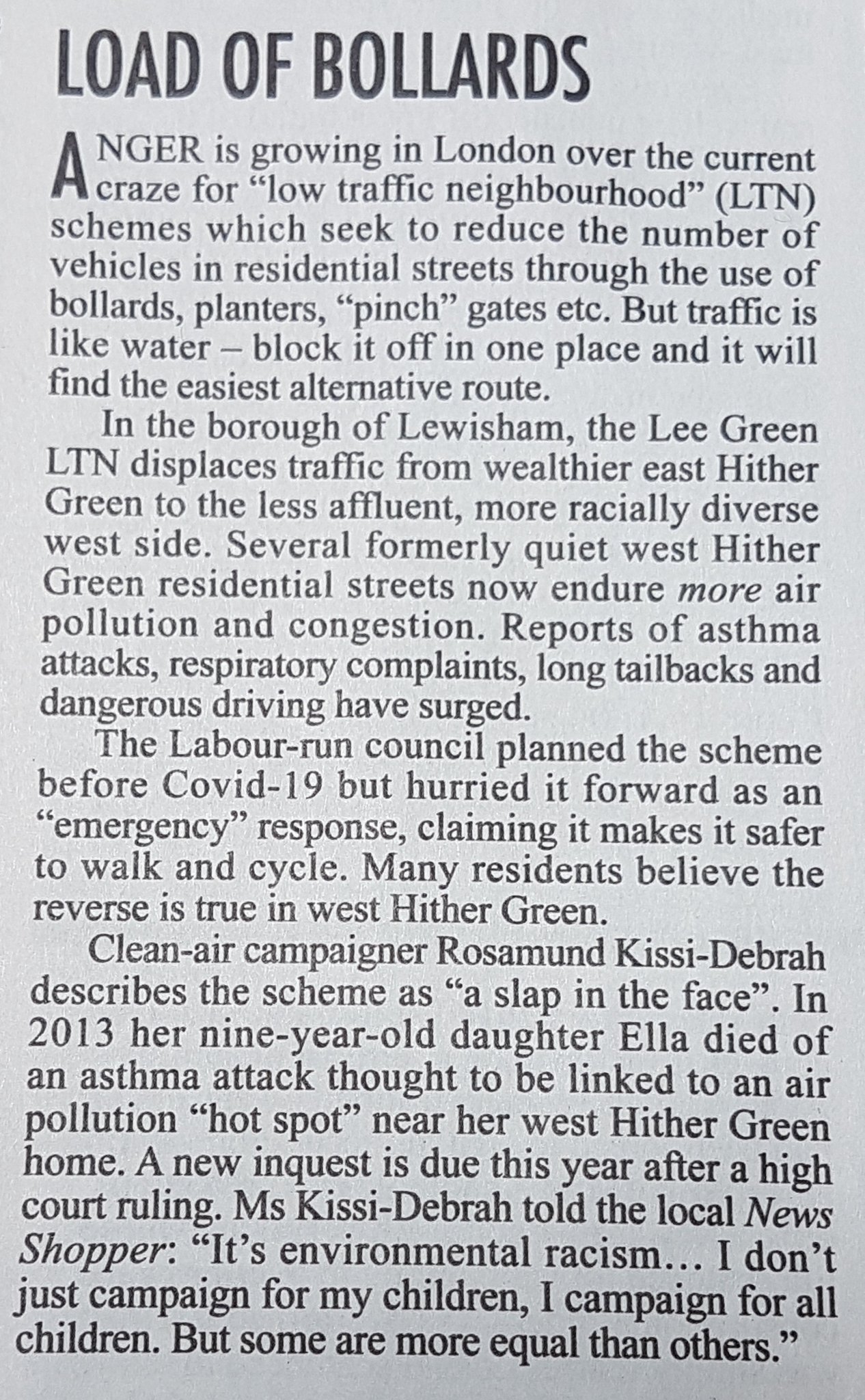
Interesting little snippet in Private Eye magazine, particularly the quote from Rosamund Kissi-Debrah, mother of Ella, whose tragic death was linked to air pollution:
Complaining about air pollution is like complaining about aircraft noise. It’s like the old adage ‘you’re not stuck in traffic, you ARE traffic’. If you’re not driving an electric car or cycling then there’s really no point in complaining. (Yes @anon5422159 I know you Tesla).
Do people who complain about aircraft noise and live under flightpaths go on holiday by plane? Do you complain about traffic and pollution and drive a diesel?
The point of LTNs is to get more people walking and cycling. Instead people’s response has been to get in their private cars and drive instead of taking public transport let alone switching to any kind of green option. More traffic, more pollution. People are the problem.
Pollution causes thousands of deaths in London each year. https://www.standard.co.uk/futurelondon/theairwebreathe/3800-deaths-in-london-caused-by-air-pollutant-study-finds-a4345831.html
I’m happy that people are campaigning for cleaner air but LTNs are there to change people’s habits and clearly habits are hard to break with simple nudges. We need some more ‘incentives’ for people to switch.
Indeed, people are the problem, and building additional urban housing, growing the population from its already-absurd 8M people is definitely a cause of congestion and thus pollution.
Yes, I’d like to see incentives to use cleaner transport, rather than the council inconveniencing people who drive, diverting and lengthening journeys.
Cheap, efficiently-allocated ride-sharing EVs (like those being rolled out by Uber) would have been great, replacing expensive decades-old diesel taxis. But under pressure from the taxi unions, Sadiq Khan banned Uber unfortunately.
I think that’s the goal, but what they actually achieve its perhaps different. Hence the ‘traffic is like water’ analogy in the ‘Load of Bollards’ article.
Walking are cycling are also impractical for many journeys and so are no silver bullet on their own. I think that should be acknowledged and efforts to improve other transport, and get the most polluting vehicles off the road should be stepped up as fast as is practical.
There’s the root of the problem. Traffic is caused by cars.
Traffic is caused by cars when the road network is inadequate to meet demand, or where it is suffering a blockage (eg accident, roadworks, planters etc)
It turns out that closing sides streets to traffic doesn’t cause a significant upturn in traffic on main roads- a phenomenon known as ‘traffic evaporation’ can occur- as happened in Walthamstow Village-
I think it all depends on who you listen to and londonlivingstreets.com is surely only going to show one side of the coin. Walthamstow was one of the earlier areas to try these schemes, and faced quite a backlash, though ultimately I guess it was ignored.
Here’s a write up in the ES from 2017:
They should make up their mind if it’s good or bad…
There’s links to other academic studies in the article- it was more those that have weight as it is fair to suggest that living streets could be considered less than neutral on the issue
There’s other factors too- Madrid found a large uptick in consumer spending when a large part of the city centre was pedestrianised
There was a BBC Travel show segment from 2017, repeated yesterday about Ljubljana in Slovenia - same story - it took about 3 years to ‘transform’ now business is up, employment is up, health benefits aside.
Unless it’s an opinion piece, I’d prefer newspapers stick nearer to objective reporting of events and research, which seems to be what the ES is doing in the cited articles.
Anyway, the undertakings of this scheme are too broad to generalise it all as good or bad. There are some successes, and other changes which are poorly-conceived.
Take for example this bit of lane closure just up from Waterloo station a few weeks ago:
They have narrowed a bus lane so it can’t be used by public transport or easily by cyclists, but made such a narrow strip of pavement that it is useless to pedestrians too. The intention may be good, but no-one benefits from the change. It would be better to instead remove the charity collectors (chuggers) grouped outside the station entrance who were neither wearing face coverings or observing social distancing when accosting everyone they could.
London has a population of a bit under 9 million. Ljubljana is about 300 thousand (about the same as just the borough of Walthamstow as it happens!) and “known for its university population and green spaces” according to Wikipedia. I don’t think direct comparison is particularly relevant given the vastly different sizes and demographics.
It’s a more complex picture. The reason I would like my own road closed to through traffic, is so I can sleep without interruption. The first few weeks of lockdown were wonderful; I felt properly rested for the first time in years. I think most people who want their street to be part of a LTN, simply want less noise, vibration, air pollution and litter. Walking and cycling also becomes more pleasant and safer.
With Covid-19 many people will opt to use private transport, so we will not see a reduction in car use.
The question for Lewisham is how they decide which streets should benefit from reduced traffic. So far they have been unwilling to publicly share with their constituents, exactly how they are making decisions.
There is a fundamental inequity with high speed transport - the faster and further the travel, the more disturbance and environmental damage is caused. It’s not a random coincidence that the same high speed travel (especially aircraft) that causes noise disturbance and air pollution is the very same industry that has helped spread the Covid-19 globally.
Agree with all of that.
…just a shame it’s cars and not bicycles or walking (to re-iterate ‘where practical’)
And definitely we need more transparency and a better process to track and log decisions and also outcomes.
Definitely. When I lived in #ebsworth-st I very much appreciated the road blocks at #garthorne-rd, which blocked through traffic and made my road quieter. It’s just a shame that the primary school and residents of #brockley-rise would have to pay the price for those road closures … but from a purely selfish point of view, I was in favour of them.
Now I look back at this objectively, I see how selfish that attitude was.
Here’s an infographic on the need for ‘Emergency LTNs’ stemming from reduced capacity on Buses
Arguably there are less people travelling of course, on the other hand this doesn’t take into account the fact that people many people simply don’t want to get on trains or buses at the moment.
Those numbers look odd. Only 14/57 with access to a car?
Approx half of households in Lewisham have a car.