I’d be very careful of such societies accepting public money. Good, and well intentioned as they are, they do not have the level of professionalism which can provide the sort of opportunities for good people who want to make a career in public service
This comes back to my earlier idea of electronic governance “blueprints.”
The FHS seems well run, and would probably tick many, if not all, the boxes associated with local government “professionalism” already. Could all the tick-boxes and processes be documented online in a modern “gov.uk” style, such that we could judge whether a community group is of “professional” local government standard?
I’m sorry, but I have no idea what you mean by electronic governance “blueprints.”, but it sounds like techno fantasy, and miles away from the good work done by dedicated local government officers, and civil servants. They do exist, and local community groups can work well with them - in fact, that’s one of the things which make them good officers.
With all due respect, I think you need to drop your ideological blinkers, and see people, including officers and local politicians, for what they are, some good, some bad, some hardworking, some lazy, but people first and foremost
I do see public servants as people. And I see local organisations doing the work of councils as people too.
By “blueprints” I wasn’t talking about replacing people with robots. I was just suggesting documenting online what it means to be a “professional” (in your words) local government and offering online help, so community groups can meet these requirements and share responsibilities of the council.
OK - that makes some sense, although for me ‘professional’ means as part of a respected career, in the way that solicitors, doctors, pharmacists are professional, rather than just doing things well. Getting community groups to take the lead sounds great, but it doesn’t provide a decent career path. I have frequently come across good paid staff working for community led organisations who suddenly depart, maybe because the funding dries up, or a dysfunctional board / committee to which they report. It can’t be much fun, and it can’t help get good people into these areas.
2 Likes
Thanks @anon5422159 & @TimLund for your recent posts, I appreciate, like, & understand them all 
I also must point out I am posting as me here & NOT our library group as a whole on this.
I do think it would be great if the FH Society were given a small fee by local government for costs on local initiatives so professionals could actually be paid for their services, and probably even more could get done then. At the moment I think they rely on membership fees, but @Michael would know this more than me.
I don’t sit on the FH Society committee so am not the best person to work out if previous suggestions would work.
I am one half of “Forest Hill Arts” & am “Forest Hill Fashion Week” I do go for local assembly funding to cover the costs of the later (PLI etc etc) & we will be going for funding for FHA to do more this year - All funding we go for will be to cover outgoings & not for profit & we will be trying to tap into arts funding for this specifically & not locally.
Going back to our library, personally I can tell you it’s a massive financial burden BUT one we are all more than willing to take on for the next 25 years & are all very passionate about & we don’t doubt for one second that we can deliver the best possible community library for FH.
Yes we will go for funding for certain things BUT we are not too worried about this as we know the community is right behind us.
The support from our crowdfunder was amazing and because of this we have been able to:
- Update the computer systems
- Add baby changing facilities to the toilet
- Create & build shared office space which will generate ongoing income
And that’s just so far, so hopefully we can deliver a whole lot more soon regardless of funding or not.
I must mention here that our local Cllr’s @MajaHilton @CllrPaulUpex & Peter Bernard secured £5000 assembly funding for us to be spent on “Children’s Literacy” at the library which we are looking at now & are really grateful for. So massive thanks to them for the support they have and are giving to the library 
1 Like
This (your second point re Bogota, above) sounds interesting, and I think Lewisham could benefit from something like it. Currently does Lewisham evaluate quality of services?
Yes, but it isn’t democratic. It has an executive committee making decisions and setting agendas, and no obligation to consult the membership. I sympathize with this arrangement, as the activists who do all the work, get to make decisions, but it isn’t democratic.
Quite right. I think i would be the first to object if civic societies were given blank cheques to run services that some people cared about most.
If the Forest Hill Society believe it can deliver services it should be able to bid for the work like any other group. Ward assemblies have been good to enable us and other local groups to spend a small amount of money locally on interesting projects. Bidding for Portas Pilot funding enabled the community to spend even more, with oversight by the council and GLA.
We are actually quite lucky in Lewisham to have assembly funds. This is a rare arrangement and it is a good way to allocate small amounts of money to the community. But funding has been cut, which isn’t surprising when there are more vital services that the council is trying to avoid cutting.
On the larger level i would like to see more local authorities (and police forces) joining together. Southwark and Lewisham or Lambeth have lots in common, so why not combine more of their central activities? Local authorities can get too big, and i remember when Strathclyde stretched from just outside Edinburgh to the Isle of Mull, with 2.5 million people. That was too big but two london boroughs together would include 500,000 people.
1 Like
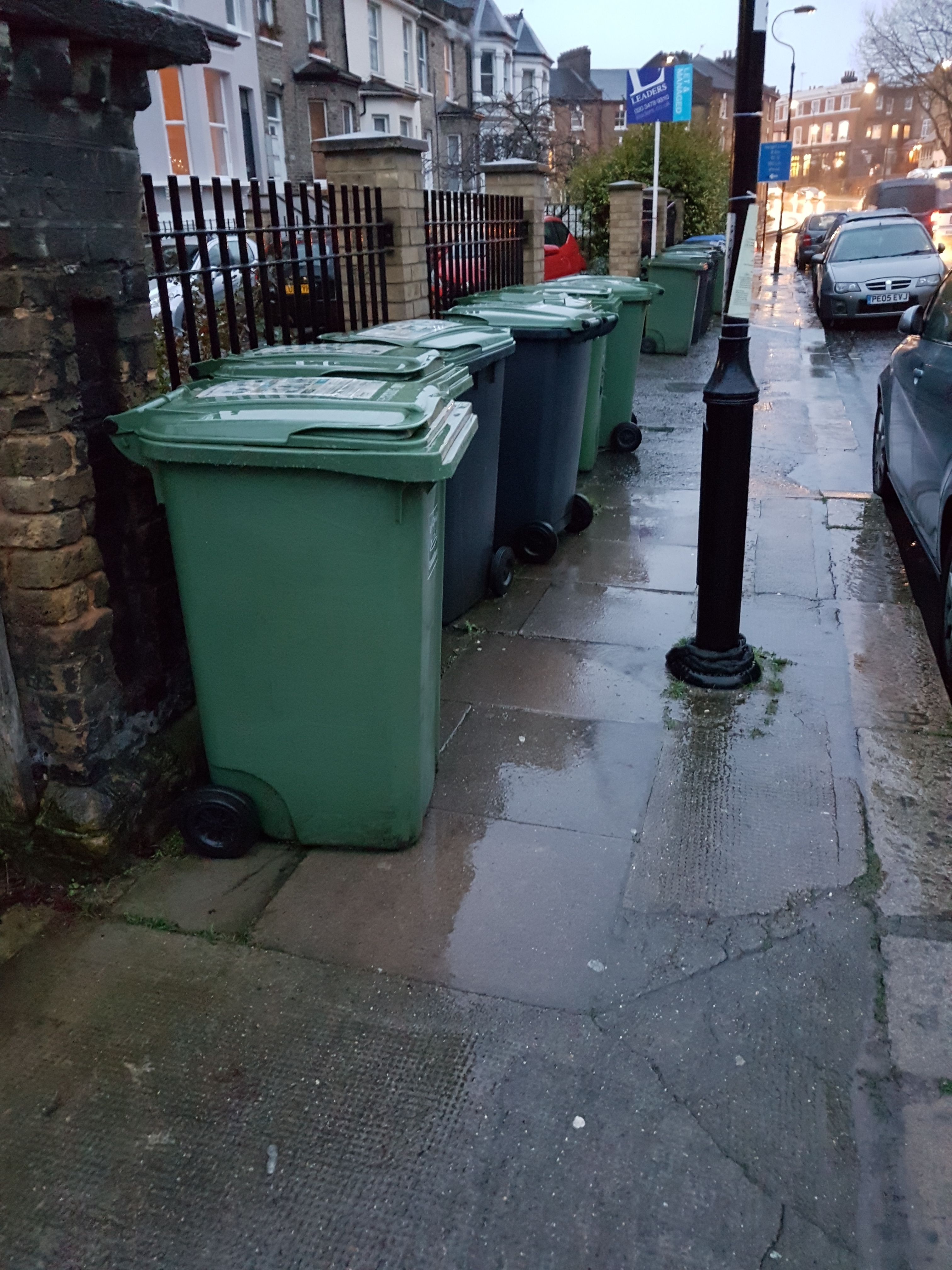
I’m back to the general theme of local government.
The picture shows wheelie bins obstructing the pavement. The residential development these bins belong to, had a planning condition that a bin store be approved and constructed as part of the development. This was never enforced and I’m told that the enforcement period has elapsed.
Planning Dept referred me to Crime Enforcement and Regulation, who in turn referred me to Envirocall (I assume this is the new name for Environmental Health Services?) Enviro_call_ no longer take calls (so why was I given their number?) and there seems to be no appropriate category that this issue belongs to for the purposes of reporting on Lewisham’s website. I started writing an online report, but the address wasn’t found and I was referred to a phone number where the automated message referred me back to the website …
So I think what we can see is that there is service provision if it’s statutory and or commercially viable and easy. Anything messy or complicated that doesn’t fall into an unambiguous category of provision, is not dealt with.
I am happy to be proved wrong. If someone in a responsible position in Lewisham Council is reading this, there’s a mess of assorted bins obstructing the pavement alongside 30-32 Devonshire Road. Some of the bins have not been emptied for months probably because they have the wrong type of rubbish e.g. general waste in recycling bins Some bins have rubbish propped on top. There is also rubbish on the pavement. There are orphaned bins stranded in random positions along the road, some numbered, some without numbers. (what are blue bins for? There’s one of those)
Similar things happen elsewhere, for example just locally I’ve noticed between David’s Road and Sainsbury’s car park seems to have a particular problem with bins obstructing the pavement, also rubbish being dumped on the pavement.
On the broader issue, have you contacted your local councillor or attended one of their surgery sessions to discuss this?
1 Like
I haven’t contacted then about this, but have about other matters - not helpful.
Given the lack of good service you’ve seen, I suppose this is something we should consider in the next council elections. Are there prospective councillors for your ward who might be better? I’d like to hear from more of them on this site if they’re listening…
I, for one, have a lot of respect for @MajaHilton (Forest Hill Ward / Labour) as she uses platforms like this to stay in touch with local residents and listens to our concerns even though she sometimes gets a bit of hostility. She’s a regular at our meetups too (although please do not acost her about rubbish bins if you meet her at one of our socials!  )
)
I worry more about the systemic and structural problems and the organizational dysfunctionality of the Council’s administration. The fact that I was mis-referred twice in relation to the same matter is alarming. Do officers not know the function of their colleagues in the administration? If they do not have basic information about who does what, then I think there is a serious problem which needs to be addressed.
Pretending everything’s OK and muddling through isn’t a policy I support.
1 Like
I don’t think that will ever be truly resolved though, do you? Without efficiency incentives, and with an effective monopoly, the state is never likely to make its customers as happy as the free market does.
My answer in general is to reduce the size and complexity of the state, and reduce its influence on our lives. And where we absolutely need it, force it to use private companies chosen via uncorrupted procurement (which is, again, another regular failing of the state).
I’m confused. Aren’t you in some way also describing PFI and PF2 programs? They were designed to have public services (transport, healthcare, services, education among many) delivered in the private sector. And in particular to remove (or at least share) in delivery risk. Does that not use private companies as you propose?
I’m unfamiliar with PF2 but (mostly Labour)'s reliance on PFI (private debt-raising to fund state enlargement) is the antithesis of what I suggested.
I’m suggesting shrinking the state and employing private companies to deliver services. Not employing private financiers to keep debt off government books. That was a huge mistake that we’re paying for in spades now.
PF2 was created by George Osborne to replace PFI begging the question whether the “I” in PFI was actually a “1”. I guess the difference is PFI (and now PF2 in England or NPD in Scotland) is best applied in substantial projects (say £100m+) which also benefit from private equity. The UK Government (both Conservative and Labour) made substantial errors with PFI insofar the procurement model was inappropriate to a number of the projects it was applied… and by moving the debt off government books. I also think the procurement process was too onerous and opaque. The problem isn’t PFI which works exceptionally well in many companies, it is how it was applied.
But yes… perhaps council services may be too small or low value for this model… unless services are bundled across many councils.
Thank you for the information on PF2. I see from the Wikipedia article on PFI that a 2011 Treasury Select Committee recommended that the “perverse incentives” of the original PFI (a Tory invention that “expanded much further under Labour”) should be reined in.
Getting back on-topic, what do others think about local government and how it could better provide services like waste collection that @DevonishForester mentioned?
I’m all for moving services into the private sector. Though I am concerned about the ability of local government (even national) to adequately procure and manage these contracts such as with waste collection. Some are better than others. In Southwark I was more than satisfied with the standard of environmental services provided through Veolia. I’m less than satisfied with the services provided by Lewisham.
I’d love to see more London councils bundle key services and benefit from economies of scale. I just don’t understand why each London borough has to have its own unique solution. If bundled thus increasing the size and value of the contract then there IS capacity to bring in additional private financing. This is not limited to waste collection… it could be applied to road maintenance, parking services the list become limitless.
Scotland has an interesting model called the Hub. The Hub…
brings together community planning partners, including health boards, local authorities, police, and fire and rescue services and several other public bodies together with a private sector development partner to form a hubCo to increase joint working and deliver best value in delivering new community facilities.
So yes. I think local government COULD do better in providing services. But I also think it can also be done differently. For this there could be an application with PFI or some other form of public private partnership.
2 Likes
Scotland has a Parliament. England is the only country in the UK not to have a national parliament. New thread? Does England need a parliament?
1 Like