However you do get more noise on the line with greater distance (we have to measure this on all our installs) - so technically this could mean more lost packets which are therefore sent again which does slow down transmission. However you do need a lot of distance to make much difference…
1 Like
I can always stand to be corrected.
But as I have said before I was a member a testing team for the FOH rollout when the architecture changed from FTTC to FTTP mid-way through the pilot scheme.
BT installed monitoring kit in my home and connected two of the five fibres that are available for data use. (the norm for a retail customer is to have one data link). Throughput, noise levels and many other things were logged and reported on about which I have little expertise.
Monitoring and testing would be done across both lines and there could be significant variation on the throughput. The supervision team spoke of “degradation” and inferred that on occasion there were issues about noise measurement and tuning of the settings on what they called their retail servers and the insitu huawei box located at my end of the fibre. Whilst in the main I now get a fairly consistent 76 mbps - there still is an occasional wobble and even more rarely a drop out.
From time to time I would be instructed to change data ports as (I assume) different configurations were tested.
In your model, is it the case then that a constant 76mbps would be maintained over a finite distance or and until it could reach a maximum distance and drop off entirely with no ramp-down in throughput.?
1 Like
Although orders of magnitude better than copper, the fact that the light propagates though an optical cable means that attenuation (absorption/scattering) and dispersion (pulse broadening) cause the max data transfer rates to slow down over distance.
Mind you, you would need to be pushing a few Gigs over 50km or so to notice the difference for normal home use - but soon becomes a limiting factor on major backbones.
2 Likes
Yeah. Fibre is also immune to a lot of common sources of interference like cross-talk from nearby lines, ground loops, water, etc. Basically a copper phone line is like a radio antenna, and picks up any/all radio interference which comes from many sources. Another benefit of fiber is that because of its “all or nothing” nature, when you get connected there is a much better chance you will get a “good” reliable connection, whereas VDSL is a lot more forgiving and will tolerate poor quality connections (albeit giving you lower speeds). My VDSL was having some issues a while back and the OpenReach tech discovered another unused phone line he could give me instead, and I instantly gained around 20% both up and down.
Any speed wobbles you see are almost certainly coming from upstream (i.e. from the cabinet upwards).
It is hard to beat a good engineer who knows his own patch - I do a little network maintenance with copper and fibre connections.
On more than one occasion with copper I have had the same experience when an engineer has patched through a “cleaner” line to improve data throughput.
Keeping on their good side is the art-form - you never know when you will need their help.
1 Like
I’ve just done a bit of reading, and FTTP is delivered via something called GPON, which shares one master fibre with up to 64 end users (I’ve no idea if BT splits it all the way to 64). It’s difficult to find exact info, but I get the impression that everyone on that shared connection is connected at the maximum speed, which is 2500 Mbps down and 1200 Mbps up. So in theory, if all 64 people maxed out their 80 Mbps connections simultaneously, then they would all get roughly half (40 Mbps x 64 = 2560 Mbps). So it’s still very much a shared resource (but then, everything about the Internet is shared, so it’s a moot point).
What I find interesting is that because this is shared, every single ONT (the “modem” that OpenReach gives you) has to be well behaved, or it can cause problems for the other users on the shared line. It also means that everyone is connected at the max speed, or again, nothing would work.
Here’s a very nerdy but useful PDF:
1 Like
Oh, I gave him a very generous tip. I was over the moon!
1 Like
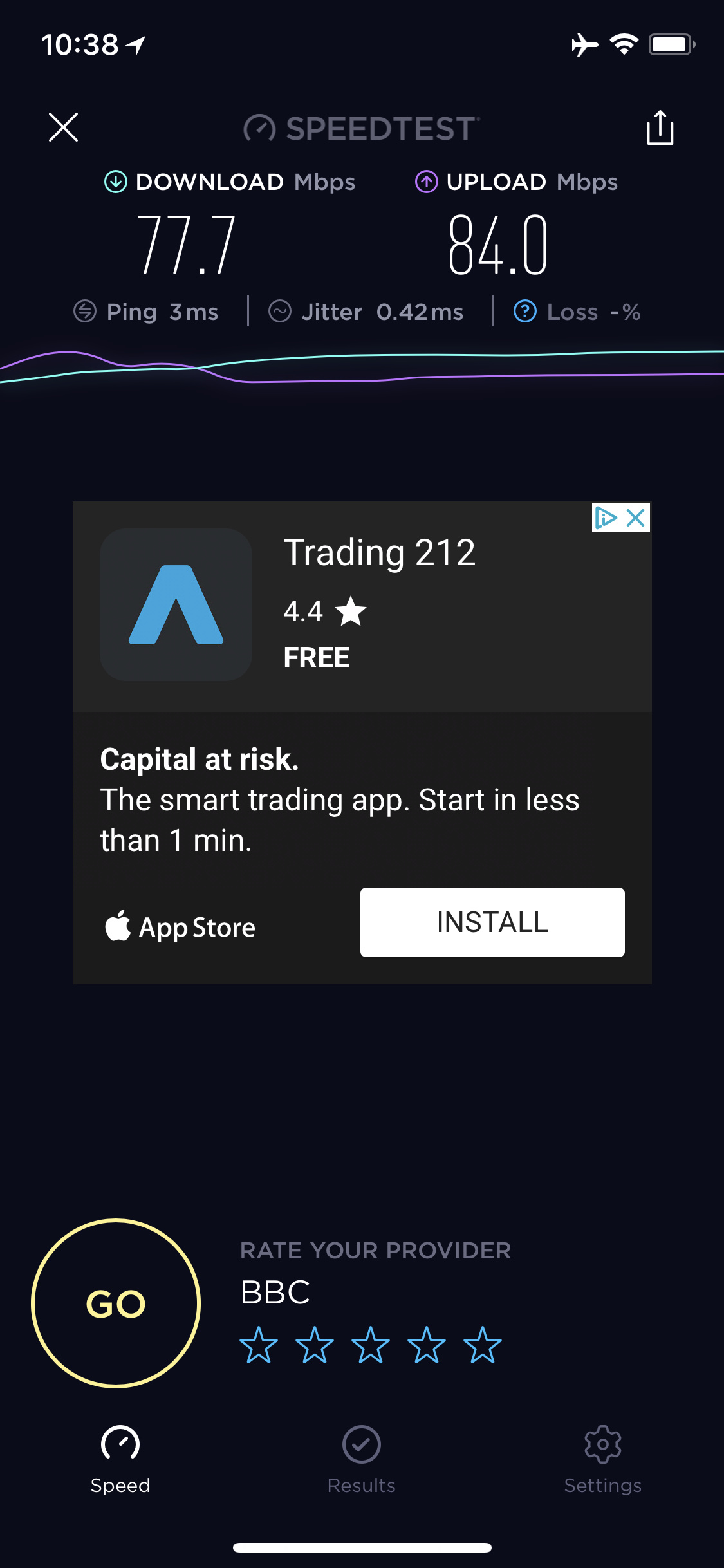
The download speed is comparable with my 76mbps - but that upload speed is phenomenal.compared with my circa 20mbps.
What is it running over and who is your ISP
I should confess that this is at work…I have no idea what it’s running over, but I work for the national broadcaster, and have just hooked my new iPhone X up to the staff wi-fi…!
Does your work extend that service to your home ? I had wondered if it was a dedicated link with non-contention installed at your home.
Ah - so the BBC logo was not an casual advert !
Sadly not!
It will be running over some sort of synchronous leased line - I get that speed here at work with ours and we are minnows compared to your employer who are likely limiting your speed somewhat. Sadly they don’t come cheap but they are much cheaper than they used to be.
Yes, I would imagine that we have a very fat pipe for broadcast critical purposes…they’re not likely to offer much of the available bandwidth to the worker bees.
We moved to Eastern edge of Forest Hill SE23 / south side South Circular in early 2016, we could only just get 16Mb broadband, but there was clearly fibre access (FTTC I think) to neighbouring properties. All the online checkers and the BT call centres denied it, I think due to capacity, even though I accosted various BT engineers in the street looking at poles to ask them, and they said it should be OK (they pointed me to the boxes on neighbouring houses proving it was there). I got the leaflet posted above a few months ago as well. Even then, BT denied availability (“Computer says no”). Happily, something changed a week or two ago and suddenly my postcode was enabled for ultrafast (FTTP I think). I’ve ordered the 200Mb allegedly going in on Monday, we shall see what happens. If you have been waiting for a while, I recommend you go check again. Lead time was about 2 weeks to get it installed if that makes a difference to you. I elected to go straight to BT for this contract - possibly paying a bit more - simply to get it in.
6 Likes
I have just bought a house on Boveney Rd and am really battling to find a fibre or cable provider with fast access, let alone superfast… any ideas
Hi Lisa. You may struggle to find a provider with fibre broadband in FH. Some areas seem to have access to fibre and others seemingly not.
My only choice was to go with Virgin. I believe they use a separate line to BT.
All the best.
Yes i would like Fibre but Plusnet who i am with dont have it in our area , the only provider is Virgin, who have a bad name from Neighbours for bad service ?
So i suppose its a case of stick with the devil you know,but not fibre ??
I was with Virgin for the past year, and while I have heard plenty of horror stories, I actually had no major issues myself with them. If they’re your only option for superfast, then you may as well go with them.
I have since switched to Hyperoptic, as I had always planned to, but they were not immediately available when I moved in, so Virgin was a stopgap. It was either Virgin or standard DSL, Virgin won out!
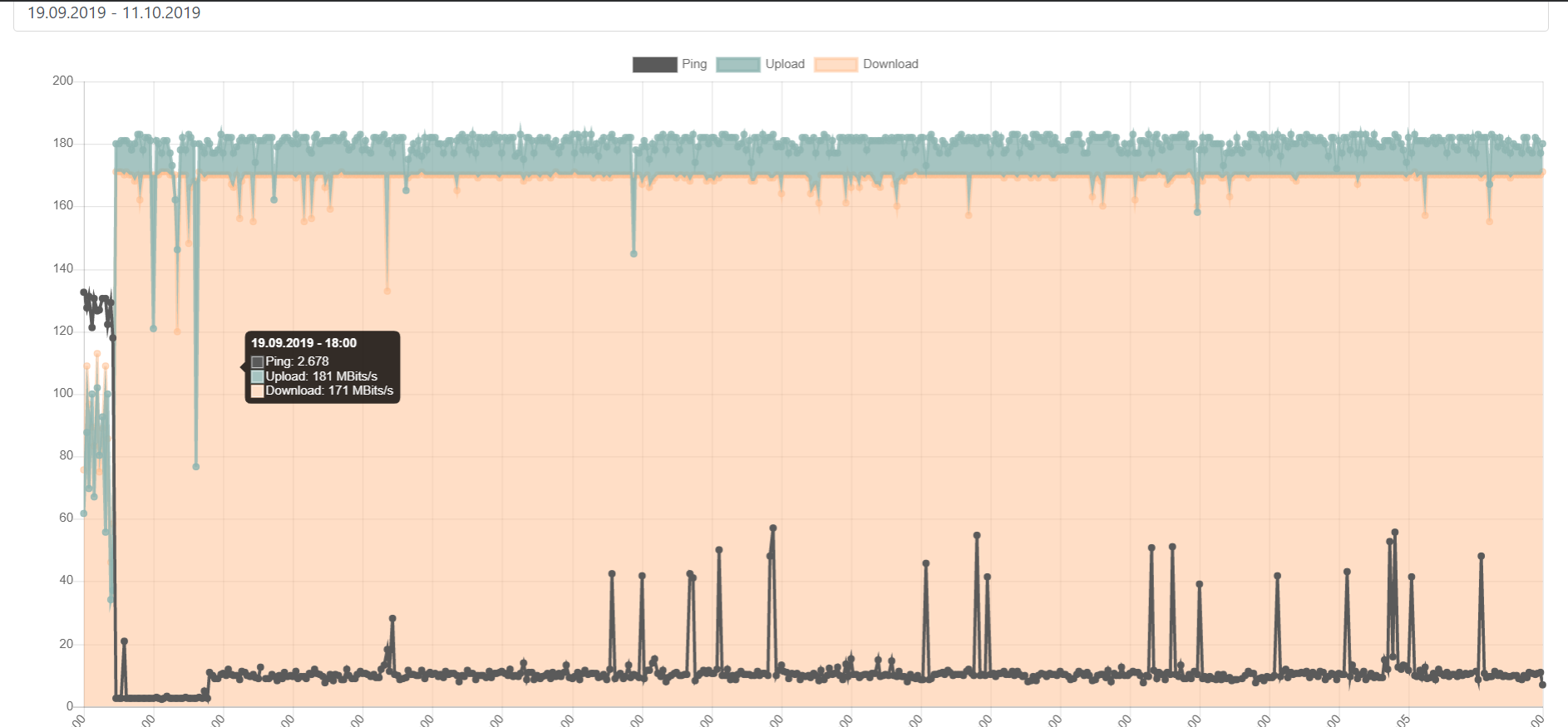
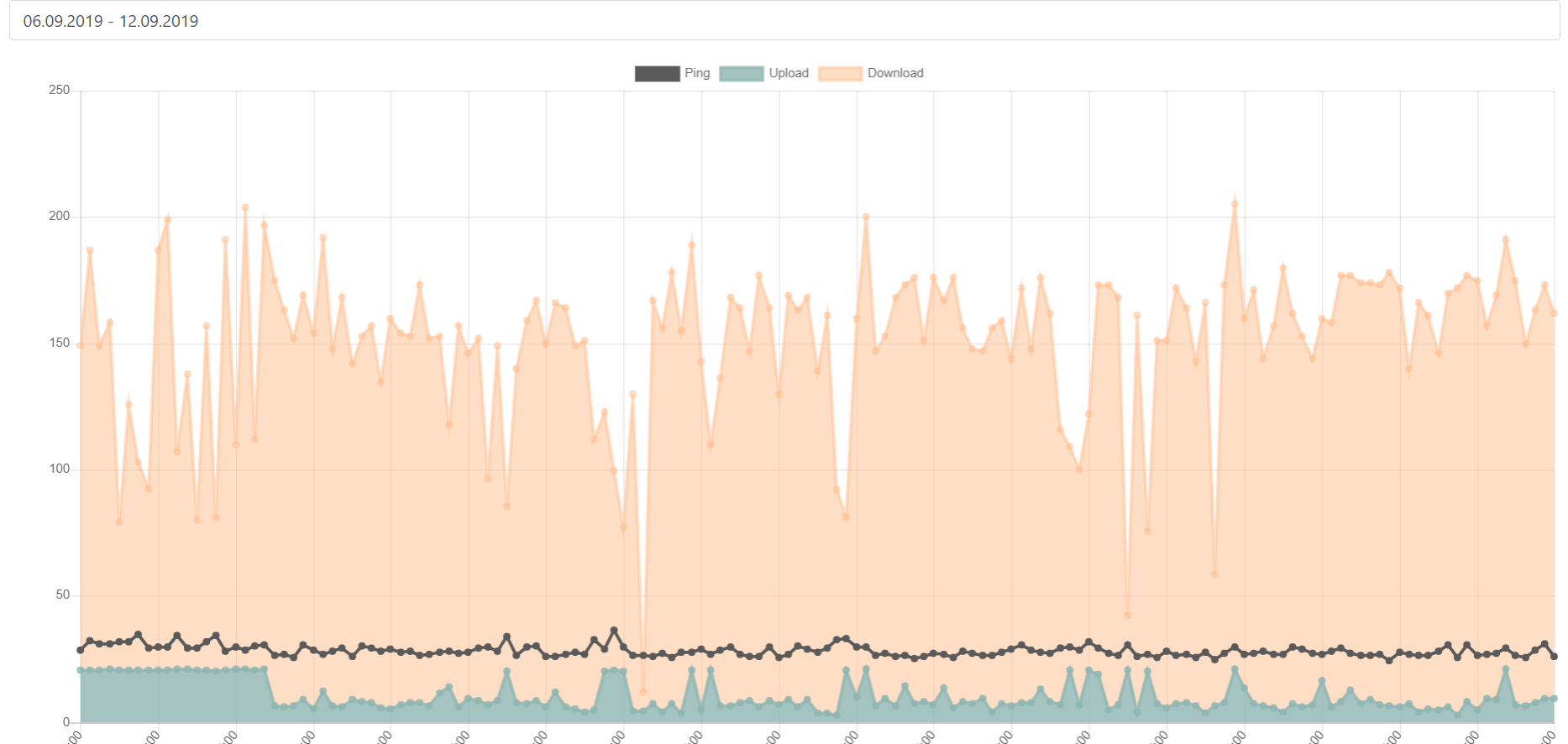
I’ve posted these in another thread somewhere before, but in terms of reliablity here is an average week of hourly speedtests whilst I was on Virgin (I was paying for the 200Mbps package)
Just for fun, because it’s not overly readable, but here is ~a year’s worth of hourly speedtest results:
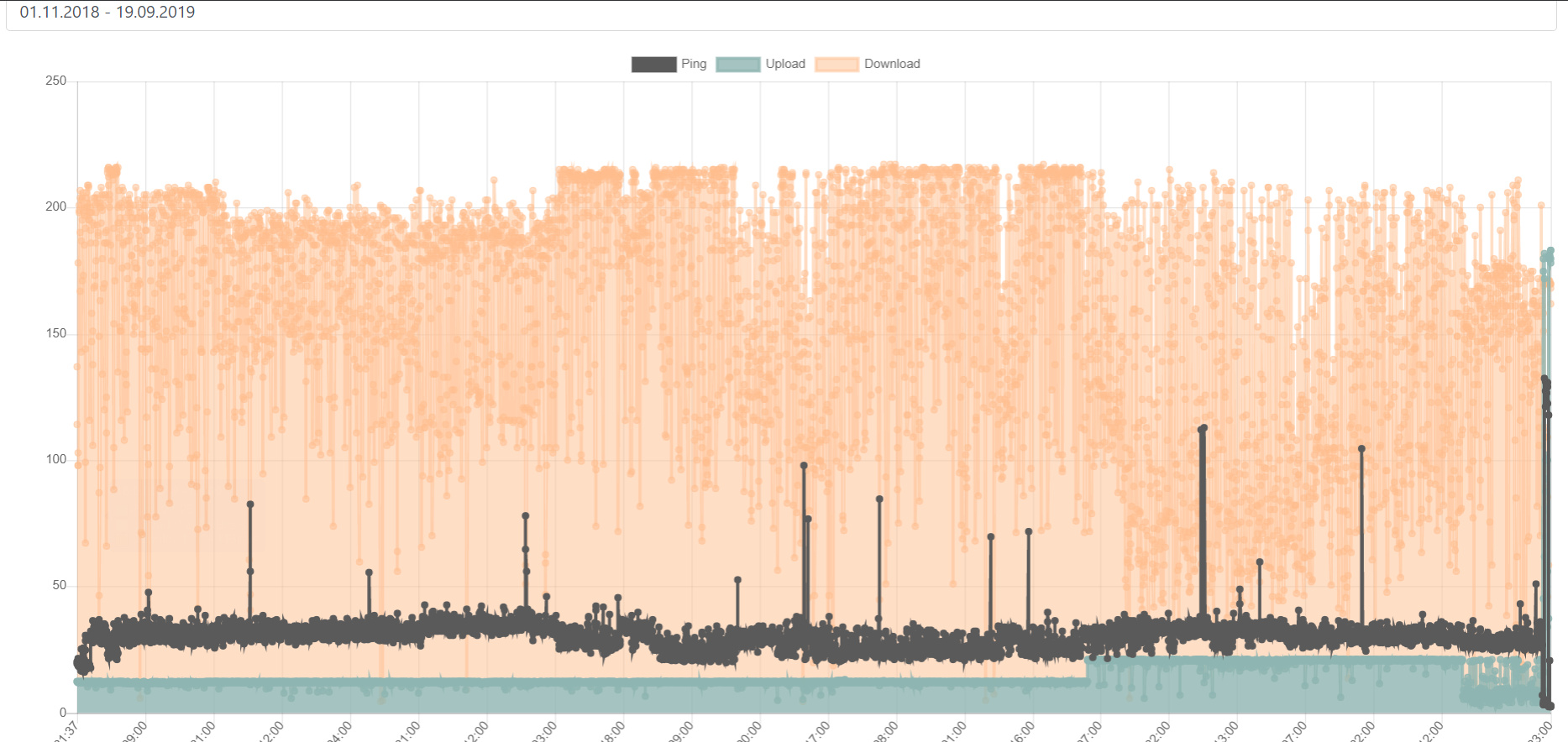
So the speed can be a bit uppy downy, but it averages out to be more acceptable than DSL, and I had not major outages.
That said, Hyperoptic has been much more consistent in the provided service, paying for a 150Mbps up/down service, and on average getting slightly higher. Here are the last three weeks of hourly speedtests: