What’s likely to happen ? Will it stay a pub or go empty ?
Are those beetroot greens with the steak?
My understanding is that the pub will remain as a pub, but be revamped.
Very possibly. I scoffed the lot so quickly I didn’t really notice. But it was all absolutely delicious!!!
My BIG bad.
How could I possibly forget the St David’s Day, the St George’s Day and the St Patrick’s Day celebrations.
And the time we all celebrated Romania’s entry into the Rugby World Cup.
And all of the non-sports occasions too of course. Linda has reminded me of the reindeer for the kids at Christmas.
The purchaser of AIO has several websites.
What appears to be some conceptual elevation sketches marked Forest Hill 2019 appear here (there is also an elevation photo of the contemporary building):
http://www.vanquishiconic.com/crib-11/
The elevations look like this:
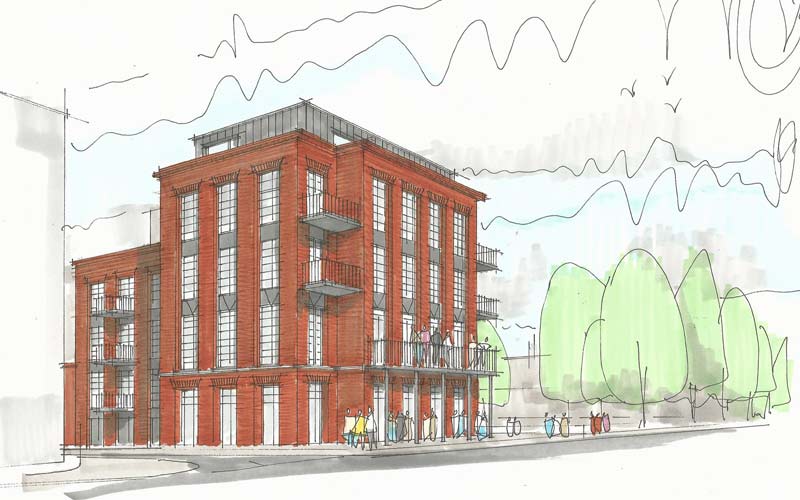

The introduction of iron-work on the Perry Vale elevation is reminiscent of the style of the building that is the predecessor to the contemporary building. I am certain I have pictures of the previous pub plus a brewery/dairy all taken before the WWII bombing.
Whilst I am advised that there is a capped well still present in the undeveloped bombsite it makes one wonder if a potential developer might give consideration to extending onto that site too.
Those plans would mean the complete redevelopment of the site for flats, possibly with a commercial use at ground floor fronting Perry Vale. It would suggest the loss of the Public House which would be a real shame as the AIO has a traditional style and has been a hub of the community.
Also the experience of the residential development opposite the station makes we concerned. The commercial units remained vacant & boarded up for a long, long time. There is now the great convenience store & there was the Perry Vale, which has subsequently closed.
The AIO is a significant presence on Perry Vale that brings an active frontage and is a draw/destination point. It has attracted people from ‘across the tracks’ which had divided Forest Hill.
I wish R, J & J all the best & they will be a great loss.
1 Like
Oh. I had assumed that meant another pub Co was taking the site over.
My understanding is that there will still be a pub. This may be a requirement of Lewisham Council.
In addition, by doing away with the pub, the developers could be making things difficult for themselves as they could be laying themselves open to multiple objections to any proposed scheme not involving the retention of the pub.
Lewisham Council have no authority in retaining a public house.
I stand corrected.
Wouldn’t the Council have something to say about change of class?
Although, on reflection, the developers of the old Greyhound pub site in Sydenham were given permission for the development, with a condition being that the Greyhound pub was retained. They, the developers, then demolished the pub, resulting in a concerted effort by residents for the pub to be restored, which it has been, to the very successful and popular new Greyhound pub.
Again, I stand to be corrected if I have not got the correct facts.
This may clarify Lewisham Council stance regarding pubs.
The funny thing about this is that the planning department at Lewisham attempted to protect the pub as it was their local.
An Article 4 direction removes permitted development rights in a conservation area. They wanted to retain the pub & prevent it becoming residential.
I’m not sure Catford Bridge is a CA.
I remember that there were protracted discussions with Sainsbury’s about the redevelopment. I’m not sure if the Greyhound had any protected status, but it was rebuilt in the style of the original building
The Greyhound in Sydenham is a very special case, involving very shady operations by the developer followed by the most vocal and concerted public campaign I’ve seen locally in nearly 20 years of living in the area. I doubt the result of the pub being rebuilt would serve as an example of Lewisham’s planning approach to retaining pubs in general.
1 Like
The Greyhound’s ultimate saving factor was the fact that SydSOC, to their credit, persuaded the then named English Heritage to deploy their newly invested powers to apply an “instant listing”. EH decreed that the mural, which if I recall was located in the hallway of the original building, merited such a listing.
The fact that the listing thereby existed offered a cornerstone for all actions against the developer who had elected to prematurely demolish the building. Many will view the tenacity of everyone involved in the reconstruction of the Greyhound as being meritorious - there are very few critics of this successful outcome and particularly the appropriate and measured use of the planning laws in full.
However in recent years local councillors, amongst others, Cllr Liam Curran and Cllr Tom Copley have publicly pronounced that permitted development rights represent a loophole in planning processes and have furthermore have advocated the application of Article 4 Directions where the properties and structures involved do not meet the criteria for such an application.
To suggest that there is such a loophole and that owners and developers egregiously mis-use their permitted development rights is factual, logical and political nonsense and frankly represent a form of populist politics that pursues any votes wherever they may be found.
Further pronouncements have been made about “generalising” the application of some type of Article 4 Direction to all local pubs. This simply is not feasible. The pub market is shrinking and in a Lewisham wide context a number of pubs, some with real qualities and customer loyalty have failed and been closed.
Permitted development rights are essential in the UK and are applied in ALL of our major service provider, transport infrastructure and communication sectors. It is essential that our providers have the capability to build and develop infrastructure networks, industrial processing plants and such ancillary buildings as are required to manage and operate these assets in the fullness of their life-cycle.
Naturally the proposals to erect and build such assets will be subject to the exigencies of the UK planning procedures. There are very few exceptions - in recent times I can only think of one major example - the Docklands development, where all planning decisions were delegated, if my recall is not faulty, to an independent Development Board.
To the point, when these assets become life-expired or redundant and require demolition (irrespective of whether a modern equivalent replacement is required), the owner must be permitted (and possibly required, under enforcement) to demolish any asset that is deemed redundant. The absence of of such permitted development rights could probably result in a much smaller portion of redundant assets being demolished, particularly if the owner calculates that it is cheaper to to let the asset rot, irrespective of the blight it may represent to its neighbours.
The Article 4 Directions are applicable to buildings and structures within the boundary of a Conservation Area (CA), which are not listed but may have specific characteristics that merit prevention of demolition.
AIO is not in a CA. Under normal rules an Article 4 Direction is not applicable. The values that must be weighed when considering a change in rules must be be contemplated carefully. It is an example of what could easily become subject to many unintended consequences.
If the new owner of AIO develops plans that include a pub restaurant on the GF is there a sufficiency of desire or need to retain the existing building ? What if the (as yet undeveloped) plans include the extension of the restaurant footprint into the first floor ? Is there sufficient customer demand for any such extension ?
I have said before, I am sorry Richard and Julia are moving on. But even if the existing building were to be retained on its existing footprint by the new owner, the building would undoubtedly be remodelled, naturally new teams would be managing the pub and restaurant elements and as sometimes can happen these changes may or may not be well received by customers.
Therefore, irrespective of whatever measure of success emerges, does it really make any difference to whether the re-modelled pub is in the existing building or is part a new envelope?
If however the developed plans eliminate the the pub restaurant element, show me the petition, I’ll sign.
So… am I right in thinking that there will NOT be a pub there anymore, provided CRIB 11 gets approved?
I’ve no problem with a good pub being part of a new development especially if it comes with modern HVAC and good natural lighting. But I think a pub loses something without some decent exterior space be it a small beer garden or sheltered patio.
I don’t see that in the CRIB 11 drawings.
1 Like