Indeed, and what safer and more pleasant roads we’d have. Herein lies the difference between libertarianism and authoritarianism 
How the heck did you get the word “politics” into this @anon5422159
Not sure if I am impressed or disappointed lol
As for the whole debate, my line on this is as it has been all along. All parties need to play their part in the matter. Obviously cars being licenced, loved / hated, and the most dangerous, are the simple solution.
1 Like
My view on this one is that local authorities tend to use the 20mph limit as a panacea for anything traffic-related. It’s the old “if the only tool you have is a hammer, every problem looks like a nail” approach.
Generally slowing traffic in cities is one way to reduce fatalities from accidents, and a 20mph limit will have the effect (generally, on average) of slowing traffic. However, I would agree with a lot of the points above which question whether it makes the roads (and pavements) safer. In my own fairly limited anecdotal experience, Sydenham Hill has become like an F1 track with a safety car deployed - you get someone (like me, I have to admit) doing 20mph and a bunch of people dangerously overtaking. In other places (like for example the Stanstead Road / Perry Vale area where I live) you get a 20mph zone on some fairly wide residential streets which is practically ignored by everyone - and which incidentally doesn’t meet any of the government’s guidance for signposting 20mph limits.
The upshot of all of this? There might be lower average speeds, but there is less uniformity in how drivers behave, and given that the ability to predict the actions which others are likely to take is probably the most important thing in road safety, that seems counterproductive to me.
I know this might be simplistic, but I’d like to see more of the American / Canadian model of traffic policing with less automation and more traffic police. This should be something which is either cost-neutral or profitable since they could levy fines / impound cars (and maybe sell them) and would be much more of a deterrent than our current approach which is so easily ignored by so many.
3 Likes
@Dave Agree totally. The issue addressed in your last paragraph is one we are unlikely to see any time soon. Given my level of interaction with the police over the last 2 weeks (and it’s quite a bit) they are overstretched, undermanned and tired. Very tired. I very much doubt that traffic policing (unless it is in relation to an RTC or significant event) is very much a second or third priority in Lewisham atm.
2 Likes
Simply, a community cannot be governed from afar by putting in more signposts. Just like the unpopular university dorm autocrat that puts notes up everywhere about other peoples’ behaviour - it just creates emotional distance and mutual resentment. The answer is to have the community empowered, and visible on the street, helping the police catch the worst offenders, while letting all other drivers get on with their lives.
1 Like
I’ve lost count of how many times we’ve been driving at 22-24mph and someone has accelerated past us to overtake. Very dangerous!!
A driving instructor has posted on the Sydenham forum in the past complaining that she can’t safely teach her pupils to manage higher speeds in Southwark (and now Lewisham). She goes out of borough.
2 Likes
I’m glad that she does that. While it is all very well having localised limits, it causes confusion for new drivers between boroughs. Assumed limits etc.
Not saying its completely wrong, it is strange to have local differences, and speed limits changing half way down a road.
At some point Google maps etc will actually start routing traffic around places to maintain a higher speed.
1 Like
After being undertaken by a bus today (while I was doing 20mph) I got thinking.
20mph is all well and good… OK it’t not actually, it’s still badly thought out in my eyes, but hey, it is here now, so suck it up.
But here is a question. On a lot of the main roads (non red routes), there are many many buses, large vans and lorries, all now also required to not exceed 20mph, although most will.
So the question.
Given that large vehicles have longer stopping distances, should they not have lower speed limits. God forbid they were to impose them. But where in the new scheme was consideration given to larger vehicles.
Have a look at the graph below to see what I mean.
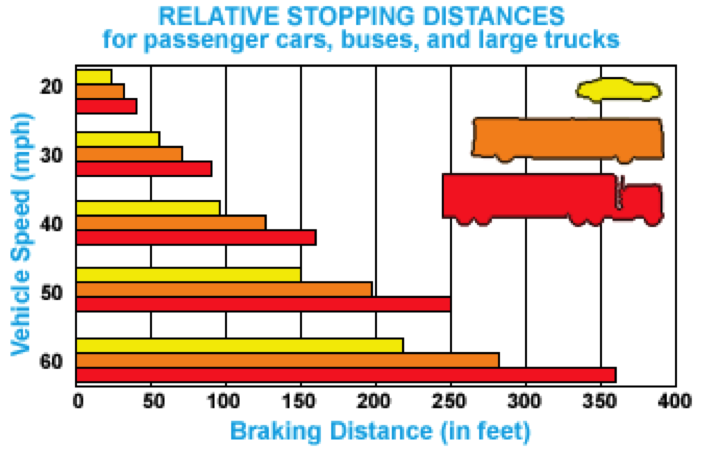
From your graph, a HGV travelling at 20 mph can stop in a substantially shorter distance than a car travelling at 30 mph. I think this supports a lower speed limit in general. Also, having different classes of vehicles with different speed limits will encourage overtaking, which is a very dangerous manoeuvre.
Critics have accused the government of operating a nanny state and some drivers have complained their personal freedom is being infringed …
Junior Transport Minister Linda Chalker said: "Nobody likes being told to do something when they haven’t seen for themselves the sense of it.
The above quotes were from 1983 when drivers were ordered to wear seat belts.
1 Like
For cars yes, but for larger vehicles? Is it just pot luck then? That said the calculations are both ball park and out of date.
My point was not that 20s should not exist but if they do, surely it’s about stopping distance not speed, in which case larger vehicles should go slower, as they do on motorways.
The speed limit being disjointed is aggravating. Very much like when most councils allowed motorcycles into bus lanes but some didnt. I spent a considerable amount of time looking at signs when I should have been looking at the road.
2 Likes
I have to say, a few days in and the rollout of the 20mph is a HUGE success.
I haven’t see anyone going over it on my trips to and from work etc. Really quite impressive.
I jest, I am yet to see anyone sticking to it for any duration, certainly doesn’t seem to have had much of an effect. Maybe putting up some high profile advertising would have helped. Yes there are round red and white signs with numbers in them, but its very easy for commuters to become sign blind on regular drives.
Also curious if this has impacted on bus route timetables.
Also noted a 4 car smash on Stansted Road last night, could have been avoided if the speed limit was lower.
I admit to being thrown as I walked along Brockley Rise yesterday and realised it’s now a 20mph road. It’s a point which has been made before, but putting these sorts of artificially low limits in place without changes to the streetscape to make them feel more natural and appropriate will reduce the subconscious adjustments to their environments that drivers should be making (instead they’ll be looking out for a roundel with a number to tell them what to do).
I think most of those who have spoken on this are skeptical about the value of enforcement of the 20mph limit, but I fear after a few days that drivers are going to find their speed attenuated on main roads by traffic and then speed up on side roads.
That would be the side roads where people are more likely to be crossing / kids playing.
2 Likes
There are plenty of changes planned for the “Brockley Corriidor”:
http://lewisham-consult.objective.co.uk/file/3081917
Have to say I think that it is through schemes like this that the speed limit behaviour will be, not so much enforced, as nudged. I think the Crofton Park stretch will be targeted first as this has been an accident blackspot.
1 Like
Nice share Brett, thanks for that. Will give that a look over in detail later.
No worries. I think this is a more recent version which also mentions the priorties due to accidents:
1 Like
I wonder if they are taking into consideration the post rollout reviews of the 20mph zone too. In the announcement they said after the launch they would review traffic flows, impact of the limit change, and put in physical measures where needed.
I hope the two projects are being worked together, and won’t end up in a rework of the rework.
Well the later copy does mention the 20mph limit as part of the safety design. It is a shame Honor Oak Park itself is not included in this but hopefully that will come.
1 Like