yes I share that experience both as a driver and as a cyclist. I remember some of the very earliest Perry Vale Assemblies where speed was identified as the major issue residents wanted to be addressed. We would have been happy with a 20mph limit but naively expected that it would be enforced in some way.
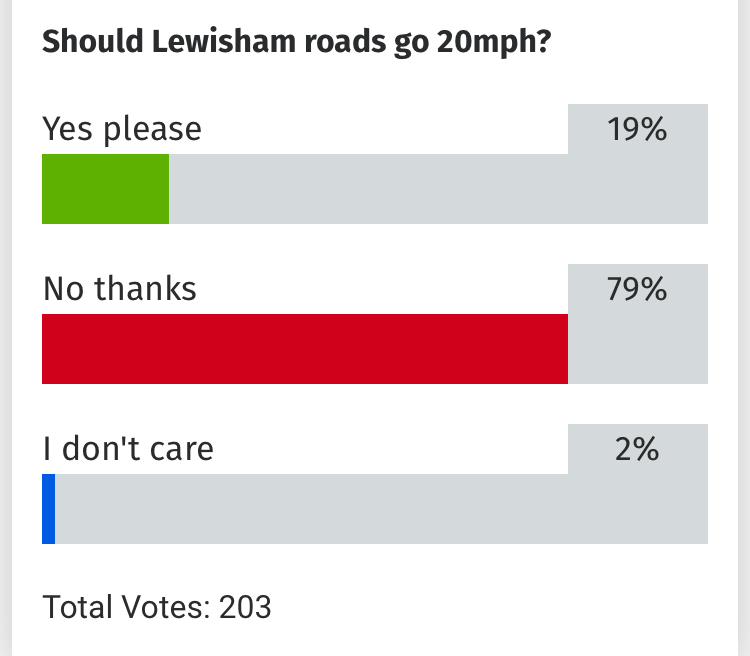
In Perry Vale I think I drive around up to 25mph - whereas before the limit I would stick at 30 ish. This sometimes gets me tailgated, but I reckon if I support the limit then I should act like it too - maybe I have some responsibility here, and can’t just look to others to make it happen. The more of us who make an effort, the more we can gradually influence others around us to accept this as normal. We know that this limit has great popular support. Why don’t I drive at 20mph ? Because like you I find that seems to induce some drivers to attempt unsafe overtaking. It’s my compromise I suppose.
My own behaviour change seems quite representative of the average driver. Nationally, one of the research studies mentioned above says that:- ‘Evidence suggests 20mph limits result in a decrease in average driving speeds of between one or two miles per hour, and studies of speed limit reductions across the world imply that this reduction in speed would lead to a drop in collisions of between six per cent and 12 per cent.’
For me, that’s one very promising outcome, that is a very significant drop in accidents, with savings for the many agencies and families who get caught up in them.
I think it takes time for public health and social innovations to stick, and to get general public acceptance. Compliance with limits, new or old has never been 100%. There will always be drivers in a tearing hurry, people who just don’t care and late night boy racers. We had another quite serious looking accident in Perry Vale just a week or so ago, and from the look of the car damage I doubt the limit had any impact at all.
Reading around this, traffic management experts have considered evidence and different approaches. The most cost effective way of achieving a mass change in speed is to do signage only across all the roads - which is what Lewisham has done. If it is true that overall collisions are reduced by that amount, then it represents very good social value - in terms of reduced health costs, loss of life, injuries, jobs and so on.
Reinforcing limits through infrastructure (humps, pedestrian crossings etc) is very expensive, and it looks as though they can only be done on a small scale where there is a particular need. eg accident blackspots, rat runs. General enforcement does not look like a priority for the police…
There’s one other outcome that is quoted in these studies; that is though the average reduction is 1-2%. it is on the roads where much higher speeds were previously encountered that the biggest difference happens. In a road like Perry Vale that might mean something like an average of 35 mph before the new limit and somewhere under 30mph with the new limit.
This would be an improvement for the people who live work and play here.